Email-Savvy People — Five Habits of the One-Line Reply
Email-savvy people aren’t the ones writing the longest, most polite emails. They’re the ones giving the receiver 30 seconds back. Five habits behind the one-line reply.
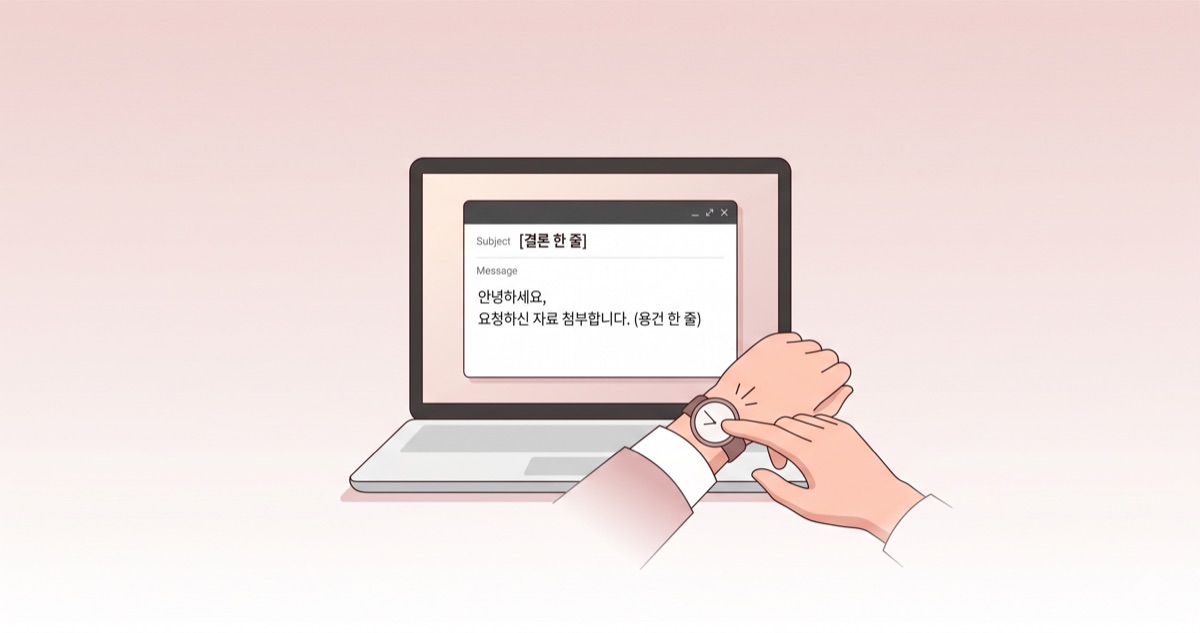
There are email-savvy people too. A well-written work email isn't the long, polite one — it's the one that lets the recipient figure out what to do in 30 seconds. The people who take the least of the recipient's time end up being the ones who get the most replies.
All the behaviors of email-savvy people compress down to one principle: when one line is enough, send one line. Anyone who has that principle in mind tends to produce the five habits below.
Email-Savvy People End in One Line
McKinsey's analysis reports that the average professional spends 11.2 hours a week on email. Out of the 121 messages received daily, only about 24% are actually meaningful — the other 76% are newsletters, automated alerts, and unnecessary CCs. Inside every recipient's head, there's a constant background task of sorting that 76% from the 24%.
Email-savvy people send the kind of email that shrinks the sorting task itself. Their email lets the recipient see, in 30 seconds, "This is meaningful, and here's what they want me to do." The five habits below produce that effect.
Five Habits of Email-Savvy People
1. Put the Conclusion in the Subject Line
A subject like "Quick question" tells the recipient nothing before they open it. An email-savvy subject shows the decision and the action directly.
❌ "Quick question" ✅ "[Confirm needed] Move the X review to Fri 5/24?"
From the subject line alone, the recipient should be able to read both what's being asked and roughly when. Subjects that can't carry the conclusion almost always belong to bodies that can't either.
2. Put the Ask in the First Line of the Body
If the first line of the body is the greeting, the recipient has to scroll one more layer to find the point. Email-savvy bodies put the ask on the second line, right after a single greeting line.
"Hi ○○, Could we move the X review to Friday 5/24?"
Those two lines alone let the recipient decide whether they can answer. An email that opens with five lines of pleasantries, then background, then finally drops the ask in line eight, is an email the recipient probably won't read twice.
3. State Exactly What the Recipient Needs to Do
The most-skipped habit. The end of the email has to carry a single line stating the request so the recipient can actually act.
"Ask — please confirm 5/24 availability by Thu 5/23 11am."
Without that line, the recipient gets to the end and has to think "so what exactly are they asking me to do?" Emails that make recipients hesitate to reply tend to stall right there.
4. When It Gets Long, Move It Out of Email
When an email is creeping past five lines, that's usually a signal it should be a quick call or a Slack thread, not a longer email. Email-savvy people read that signal early.
"This is going to get long over email — could we grab 10 minutes today or tomorrow? Around 4pm works on my side."
From the recipient's side, a five-line email costs five minutes to answer; a ten-minute call ends in five. There's a real gap between people who feel "email is a short room, longer things belong elsewhere" and people who don't.
5. When One Line Closes It, Send One Line
The most common reply mistake is the long quoted block plus a long answer plus a closing line. An email-savvy reply is just one line.
✅ "5/24 works. See you at 11." ✅ "Got it — I'll reply by tomorrow morning."
A one-line reply isn't curt. It's the cleanest possible form, giving the recipient five seconds to decide their next move. People who write five lines when one would do tend to write ten lines when five would do — the inflation compounds.
Why Emails Get Long
Long emails aren't usually a sign of politeness. They're more often the trace of a sender whose own head wasn't sorted before they hit "compose." When the conclusion isn't clear, you start writing background. When the ask isn't precise, you end with "please review and let me know."
Conversely, email-savvy people's messages stay short for a simple reason — they figure out the conclusion and the ask in one line, in their head, before they start writing. That line lands in the subject, lands again in the first line of the body, and is restated at the end. Same content, half the recipient's processing time.
Email isn't the writer's stage. It's the room where the recipient has 30 seconds to decide — that one shift in framing is the shared root of all five habits above.
What Reads as "Not Email-Savvy"
The inverse pattern, spelled out:
- A vague subject like "Quick question" or "Hello" with no signal of action
- Three lines of greetings and background before the ask shows up in line five or later
- An ending of "please review" with no specific request and no deadline
- Letting an email drag past five lines without offering a call or thread instead
- Writing five lines where one would do, then ten where five would do
These five reliably accumulate in the recipient's head until they generate the fastest path to "I'll deal with this later." Emails that don't get answered usually aren't because the recipient is too busy — they're because the email itself is too heavy to answer.
Whoever Takes the Least of the Recipient's Time
In the previous post, I wrote about the five habits of meeting-savvy people. This post is the same pattern playing out in a different room. The shared rule between the two rooms is this: it isn't the length of your own contribution that gets called "savvy" — it's how much processing time you save the other side.
Meetings run an hour and emails run three minutes, but the same principle applies. Replies come back faster when the original message was short. The next reply comes back short too. Two or three exchanges in, everyone realizes working with that person feels lighter. The clearest definition of being savvy I've landed on for now is the posture of being aware of the other person's time.
If you change one thing on your next email, check the subject line — does it carry the conclusion? Auditing that single line is the fastest way to shift how your emails read.