Raising Deposit and Rent Together in Korea — The Statute Says Per-Item, Not Combined
When a Korean landlord wants to raise both the deposit and the monthly rent at renewal, how is the 5 percent cap measured? The statute and the government commentary both read per item: 5 percent of the deposit, 5 percent of the rent. The popular combined-conversion method has no basis I could find in law, and it quietly lets rent rise by 9 percent.
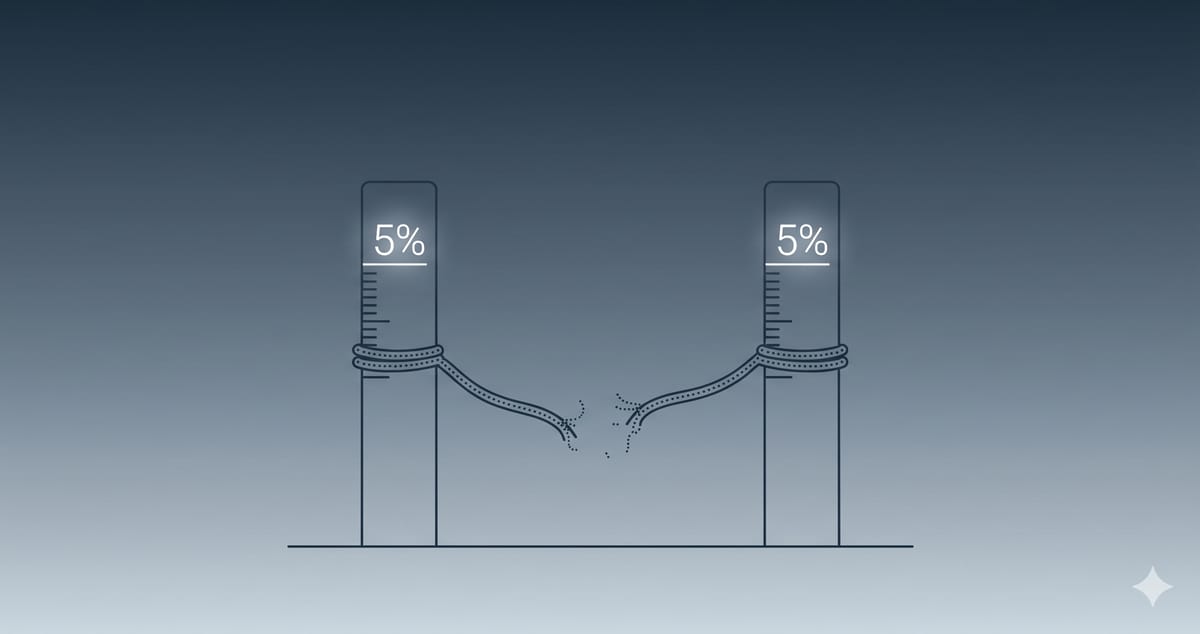
If your landlord is raising deposit and rent together at renewal, the statute reads the 5 percent cap separately for each: the deposit can rise by 5 percent of the deposit, and the rent by 5 percent of the rent. With a 100 million won deposit and 500,000 won monthly rent, that puts the deposit at 105 million won and the rent at 525,000 won. A lot of Korean websites add the two together as a jeonse-equivalent figure and apply 5 percent to the total. That formula does not appear in the statute or in the government's own commentary.
The two methods give noticeably different answers. Using the combined figure, the landlord could keep the deposit where it is and take the rent to 545,833 won, a 9.17 percent increase. Calculated per item, the rent stops at 525,000 won. That is 20,833 won a month, or about 500,000 won over a two-year lease.
Below I have quoted the statute and the commentary directly and run both methods on the same numbers. I also cover the deposit-for-rent swap, which counts as a conversion rather than an increase and falls under a different article. I could not find a government interpretation or a Supreme Court ruling that answers the combined-versus-per-item question directly, so what follows is my reading of the text, and I have noted where it could be disputed.
The statute only says "one-twentieth of the rent or deposit"
What the article actually says
Article 7(2) of the Housing Lease Protection Act:
A claim for increase under paragraph (1) shall not exceed one-twentieth of the agreed rent or deposit. Provided, that a Special Metropolitan City, Metropolitan City, Special Self-Governing City, Do, or Special Self-Governing Province may set a different ceiling for increase claims by ordinance, within the scope of the main text, taking into account regional lease market conditions within its jurisdiction.
Article 8(1) of the Enforcement Decree repeats it: a claim to increase "the rent or deposit (hereinafter 'rent, etc.')" shall not exceed one-twentieth of the agreed rent, etc. One-twentieth is 5 percent.
The reference point is "the agreed rent, etc." The agreed rent is the monthly rent and the agreed deposit is the deposit. Nothing in the text says how to merge them into one amount. There is a conversion rate in Article 7-2, but that article applies when "all or part of a deposit is converted into monthly rent." It says nothing about using the rate to work out an increase ceiling.
Article 7(1) adds conditions. An increase can be claimed only when the agreed amount "has become inappropriate due to an increase or decrease in taxes, public charges, or other burdens, or due to a change in economic circumstances," and not within a year of signing the lease or of the last increase. Five percent is the most a landlord can ask for once those conditions are met. It is not an amount the landlord is entitled to every year.
The government commentary reads it per item too
In August 2020 the Ministry of Land, Infrastructure and Transport and the Ministry of Justice published a joint commentary on the amended act. Its FAQ includes this exchange:
Q. Does this mean no rent increase is possible at renewal? No. At renewal, the landlord and tenant may agree on an increase within 5 percent of the existing rent.
The commentary says "5 percent of the existing rent." Elsewhere it says the landlord may claim an increase "within 5 percent" where "the agreed rent or deposit has become inappropriate." Nowhere does it use a converted figure as the base.
There is a separate FAQ on converting jeonse to monthly rent, with an example that turns a 500 million won jeonse into a 300 million won deposit plus 670,000 won a month. I went through the whole document, and there is no FAQ on how to apply 5 percent when both the deposit and the rent go up. Since the text already reads per item, there was probably nothing more to explain.
The same lease, calculated both ways
Take a lease with a 100 million won deposit and 500,000 won rent coming up for renewal. I will use 5 percent as the conversion rate, which is the current legal ceiling. The Bank of Korea base rate is 3.0 percent and the Decree adds 2 percentage points, and since that is lower than the alternative of 10 percent a year, 5 percent is the ceiling.
| How the increase is structured | Per item (statutory text) | Combined conversion | Difference |
|---|---|---|---|
| Deposit frozen, rent only | Rent 525,000 won | Rent 545,833 won | 20,833 won/month |
| Rent frozen, deposit only | Deposit 105,000,000 won | Deposit 111,000,000 won | 6,000,000 won |
| Both up by 5 percent | 105,000,000 + 525,000 | Same | None |
Here is the combined calculation. The current jeonse-equivalent is 100,000,000 + (500,000 × 12 ÷ 0.05) = 220,000,000 won. Add 5 percent and the ceiling is 231,000,000 won. If the deposit stays at 100 million, the remaining 131 million converts to (131,000,000 × 0.05 ÷ 12) = 545,833 won a month, which is 9.17 percent more than the current 500,000 won.
Look at the last row. When the deposit and the rent both go up by exactly 5 percent, both methods give the same answer, because the converted total also rises by 5 percent. They only diverge when one side is frozen and the other goes up, and in that case the combined method always allows more.
Put the other way around, the per-item figure never goes over the combined ceiling, but the combined figure can go over the per-item one. Until it is settled which reading is correct, the per-item figure is the safer one to work from.
Swapping deposit for rent is a conversion, not an increase
What Article 7-2 covers
If you are asked to add 50 million won to the deposit and take 160,000 won off the rent, that is a conversion, not an increase. The relevant article is 7-2, not 7.
Where all or part of a deposit is converted into monthly rent, the amount converted shall not exceed the monthly rent calculated by multiplying it by the lower of the following rates:
- a rate prescribed by Presidential Decree, taking into account lending rates applied by banks under the Banking Act and regional economic conditions;
- the rate obtained by adding a rate prescribed by Presidential Decree to the base rate published by the Bank of Korea.
Article 9 of the Decree sets the first rate at 10 percent a year and the add-on in the second at 2 percent a year. With the base rate at 3.0 percent, the ceiling is 5 percent. The add-on used to be 3.5 percent and was cut to 2 percent on 29 September 2020. The government commentary came out in August 2020, which is why it still says "base rate + 3.5 percent." If you come across a website that still uses 3.5 percent, it has not been updated since then.
A conversion needs the tenant's consent. Article 6-3(3) says a renewed lease "shall be deemed to have been re-contracted on the same terms as the previous lease," and the commentary says converting jeonse to monthly rent "is difficult without the tenant's consent." Whether the conversion stays under the rate ceiling only matters after the tenant has agreed to it.
Registered rental housing has a ministry rule
There is no combined formula for ordinary leases. Registered rental operators have a more specific rule. Article 44(4) of the Special Act on Private Rental Housing leaves the standard for "converting between the rental deposit and the monthly rent while claiming an increase in rent" to a ministry ordinance, and Article 18 of the Act's Enforcement Rule sets it out:
Where a rental business operator intends to convert a rental deposit into monthly rent under Article 44(4) of the Act, the operator shall obtain the tenant's consent, and the converted monthly rent shall not exceed the scope under Article 7-2 of the Housing Lease Protection Act. The same applies to converting monthly rent into a rental deposit.
So registered rental housing also treats the increase (5 percent) and the conversion (the rate ceiling) as separate things. There is no rule telling you to build one converted figure and apply 5 percent to it. Tax law works the same way. Article 167-3 of the Income Tax Act Enforcement Decree and Article 97-3 of the Restriction of Special Taxation Act Enforcement Decree make "a rate of increase in rent, etc. not exceeding 5/100" a condition for an operator's tax benefits, and say that conversions between deposit and rent follow the standard in Article 44(4) of the Private Rental Housing Act.
You can get the excess back
An agreement over the cap is void to that extent
Article 10 says "any agreement in violation of this Act that is unfavorable to the tenant shall have no effect." Article 10-2 spells out how to recover the money:
Where a tenant has paid rent or a deposit exceeding the rate of increase under Article 7, or has paid rent exceeding the monthly rent calculation rate under Article 7-2, the tenant may claim the return of the amount corresponding to the excess paid.
Supreme Court decision 2013Da35115 was a commercial lease case, but the statute is built the same way, so it is a useful reference. The court held that if a tenant exercised the right to renew and then signed a new contract document, it is still a renewal if that is what it actually was. It also held that an agreement to pay more than the statutory rate is void for the excess, and the tenant can recover what was overpaid as unjust enrichment. Signing a new contract does not by itself take a renewal outside the 5 percent cap.
A negotiated new contract is different
There is a ruling that goes the other way. Supreme Court decision 2013Da80481 held that the increase limit applies when one party claims an increase while the lease is running, and not when the parties sign a new contract after the lease has ended or simply agree on a higher figure. The commentary agrees that a tenant can choose not to use the renewal right and instead sign a new lease above 5 percent, and can then still use the renewal right once later.
In the end, whether the 5 percent cap applies depends on whether it is a renewal or a new contract. Before arguing over the amount, it is worth making it clear on the record that you are exercising your renewal right.
What to work through when raising deposit and rent together comes up
- Check whether a year has passed. If it has been less than a year since the lease was signed or the last increase, no increase can be claimed (Article 7(1)).
- Decide whether this is a renewal or a new contract. Tell the landlord in writing that you are exercising your renewal right. A text message or certified mail works, as long as it is dated.
- Calculate each item separately: deposit × 1.05, rent × 1.05. Check whether your city or province has set a lower ceiling; the proviso to Article 7(2) lets them do that by ordinance.
- If part of the proposal is a swap, treat that part as a conversion. Raising the deposit while cutting the rent cannot be forced on you without your consent.
- Bring the numbers with you. Writing down both the per-item figure and the combined figure shows exactly how much more the landlord is asking for than the cautious reading allows.
- If you cannot agree, apply for mediation. Housing lease dispute mediation committees are run by the Korea Legal Aid Corporation, the Korea Land and Housing Corporation, and the Korea Real Estate Board. If you have already paid more than the cap, Article 10-2 lets you claim it back.
If your lease is commercial, these numbers do not carry over. The conversion ceiling for shops is 12 percent, and above a certain converted deposit the 5 percent cap does not apply at all. That is covered in how commercial lease conversion differs from housing. If you are a registered rental operator, the 5 percent rule is also a tax condition, so see what happens to capital gains tax after rental registration cancellation as well.
Closing
Going by the statute and the government commentary, the 5 percent cap is calculated per item: 5 percent of the deposit and 5 percent of the rent. The combined jeonse-equivalent method is widely used, but I could not find a legal basis for it, and when one side is frozen it gives the landlord a higher ceiling.
I have not found an interpretation or ruling that directly answers how to handle raising deposit and rent together, so I have not presented this as settled. What you can decide is which figure to bring to the conversation. Write down both, and start from the per-item number.