When Can AI Talent Hiring ROI Actually Be Judged — Meta vs OpenAI vs Anthropic Timelines
Can Meta’s Superintelligence Labs already be called a failure at 10 months? A fact-based comparison with OpenAI and Anthropic timelines to find the right window for judging AI talent hiring ROI.
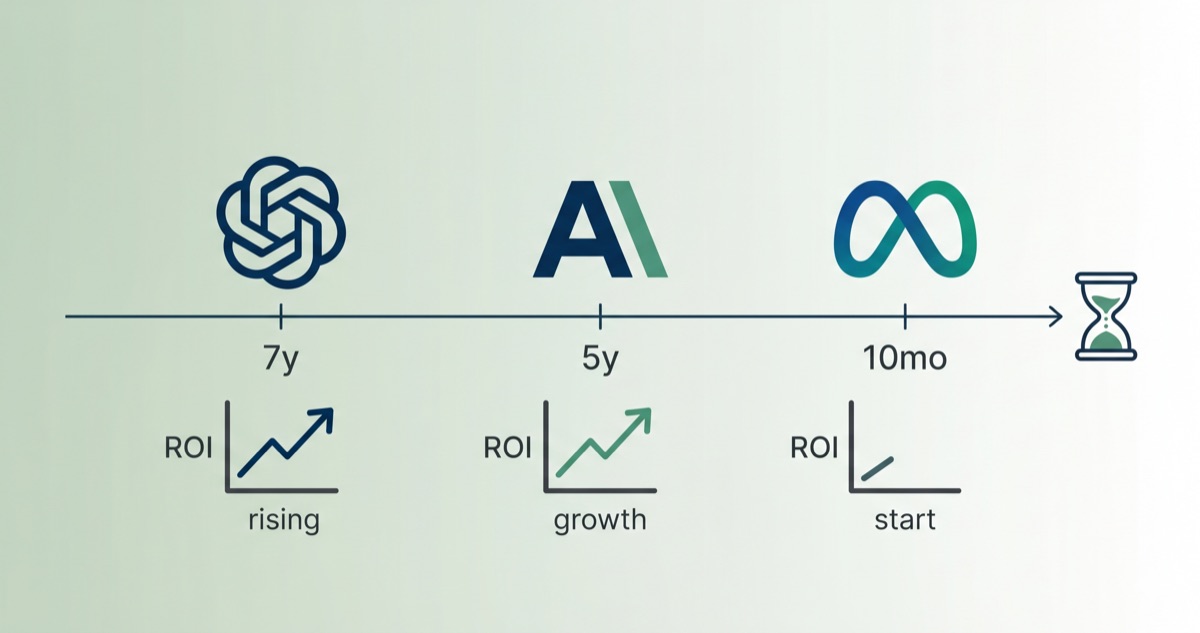
AI Talent Hiring ROI — Can We Judge It at 10 Months?
The debate around AI talent hiring ROI is heating up again. Meta's Superintelligence Labs (MSL), kicked off in June 2025 with the Alexandr Wang hire, is now about ten months old. In that window, Ruoming Pang — recruited from Apple on a $200M+ package — left for OpenAI after seven months. Reporting has also suggested that Wang's autonomy has been reduced inside Meta.
Some commentators are already calling the $14B bet a failure. But the real question is different. When is it actually reasonable to judge AI talent hiring ROI? This article compares the timelines of Meta, OpenAI, and Anthropic to find the honest answer. It's a companion to the three-pillar bet post on Meta.
Meta Superintelligence Labs — The 10-Month Receipt
Start with what Meta has paid for.
| Item | Detail |
|---|---|
| Start | June 2025 Alexandr Wang hire (CAO) |
| Scale | ~$14B package including Scale AI stake transaction |
| Co-hires | Nat Friedman (ex-GitHub CEO), Daniel Gross via NFDG |
| Additional | Ruoming Pang from Apple Foundation Models ($200M+) |
| First shipped product | Muse Spark, launched April 8, 2026 (Meta AI assistant backbone) |
The headline numbers are impressive. But the simultaneous events tell a more complicated story.
- Pang left for OpenAI after seven months (February 2026)
- Wang's autonomy was reportedly reduced — a new Applied AI Engineering org was created under CTO Andrew Bosworth (March 2026)
- Muse Spark's benchmark position is undisclosed — no quantitative comparison against GPT-5, Claude Opus 4.7, or Gemini 3 has been published
"Is 10 Months Long Enough to Call It a Failure?"
The shorthand reading is "early signs of failed investment recovery." But that conclusion ignores the time horizon entirely.
How Long Frontier AI Model Cycles Actually Take
The data from the industry shows that new frontier models typically ship in 12–24 month cycles.
- GPT-4 → GPT-5: roughly 30 months
- Claude 3 → Claude Opus 4.7: roughly 18 months
- Gemini 1 → Gemini 3: roughly 24 months
Ten months is less than half a cycle. Declaring "investment failure" at this point is closer to stopping a 12-month clinical trial five months in than to a real evaluation.
Is One Departure Enough?
The Pang departure is repeatedly cited as evidence, but one fact tends to be left out. Pang also left Apple. He had been leading Apple's 100-person Foundation Models team before joining Meta, and then left Meta for OpenAI seven months later. The pattern reads as much like "Pang is a high-mobility individual" as it does "Meta can't retain talent."
Comparing the OpenAI and Anthropic Talent Timelines
Apply the same yardstick.
OpenAI
- Founded December 2015
- ChatGPT launched November 2022 — about 7 years after founding
- GPT-3 reached general impact roughly 5 years in
Anthropic
- Founded January 2021 (by ex-OpenAI Amodei siblings)
- Claude 1 launched March 2023 — about 2 years after founding
- Claude 3 entered serious competition with OpenAI around year 3
Meta Superintelligence Labs
- Started June 2025
- Now May 2026 — about 11 months in
On the same axis, MSL has spent roughly 1/7 of the time OpenAI took to reach ChatGPT, and about 1/2 of the time Anthropic took to reach Claude 1.
When Meta Should Actually Be Evaluated
So when is the honest evaluation window? Three reasonable inflection points.
Inflection 1 — Next-Generation Model Launch (Late 2026–2027)
When the next-generation model after Muse Spark ships. This will be the first product that can be quantitatively compared against GPT-5, Claude Opus 4.7, and Gemini 3.
Inflection 2 — Personal Superintelligence Productization (2027)
When the "Personal Superintelligence" vision Zuckerberg articulated in July 2025 visibly connects to smart glasses, robotics, and the Meta AI assistant. The 2027 consumer release of the Artemis glasses is one variable.
Inflection 3 — CapEx Recovery Visibility (Around 2028)
When the $125–145B of 2026 CapEx becomes visible as revenue. Data center investment payback cycles typically run 3–5 years.
The Evaluation Trap — Short Signals vs Long Signals
The most common mistake in evaluating AI talent hiring ROI is extending short-term signals into long-term conclusions.
| Short signal (under 1 year) | Long signal (2–5 years) |
|---|---|
| One high-profile departure | Core talent retention rate |
| Absence of model demos | Market share of shipped models |
| Org restructuring | Clear R&D accountability structure |
| Near-term stock weakness | Operating margin trajectory |
Pang's exit, the Wang reorganization reporting, and the stock weakness are all short signals. The real answer comes from the four long signals, and judging those four requires at least 24 months.
The Same Lens Should Apply to Every Player
This time-horizon logic isn't unique to Meta. In the same window, OpenAI absorbed talent from Anthropic and Google DeepMind, and Anthropic kept hiring from OpenAI. AI talent hiring is a Big Tech-wide game, and one company's one-year scorecard can't decide the outcome.
The honest evaluation only happens once the next model generation reaches the market. Everything before that is closer to speculation than to assessment.
The Reasonable Posture for Judging AI Talent Hiring ROI
To summarize: Meta Superintelligence Labs' bills have arrived, but bills are not the same thing as recovery failure. The honest evaluation comes 24 months out, and what the market is currently punishing is the opacity of the recovery timeline, not the failure of the hiring itself.
For investors — and for anyone tracking the Big Tech AI race — judging AI talent hiring ROI accurately requires three habits.
- Set the time horizon at 24 months — sub-12-month verdicts are almost always noise
- Separate short signals from long signals — one departure is not a failure
- Apply the same yardstick to every player — don't single Meta out for harsher treatment
These three are enough to stay anchored through the next 18 months of headlines and back to the underlying question.