X Money’s 6% APY Reality Check — Musk’s 27-Year PayPal Comeback Explained
X Money offers 6% APY, FDIC coverage up to $250K, and a real threat to PayPal and Venmo. Here’s the fact-based breakdown of Musk’s payment market comeback — including the misconception of ‘25% principal guarantee.
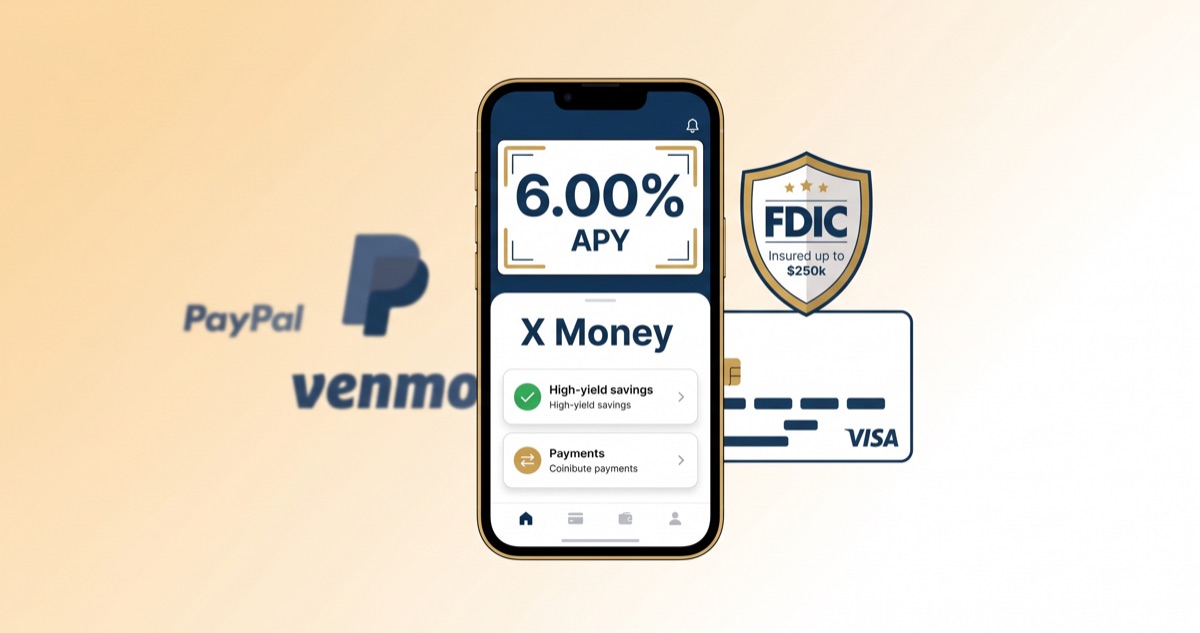
X Money — Is Musk's Comeback Really Disrupting Fintech?
X Money is expanding its US beta, and fintech is paying attention. Between 6% APY on deposits, FDIC protection, and Musk's PayPal-era credentials, the hype around the launch is significant — and so is the misinformation.
This article separates what X Money actually is from what people are saying about it. It also corrects a common misunderstanding — the supposed "25% principal guarantee" floating around in coverage. Consider this a companion piece to the recent post on Musk's empire reorganization.
What X Money Actually Is — Not a Crypto Service
The first correction to make: X Money is not a cryptocurrency product. It is a USD-based payments and deposit service.
| Item | Fact |
|---|---|
| Name | X Money (operated by X Payments LLC) |
| Beta launch | Early March 2026 (US only) |
| April phase | Expanded to early public access |
| Coverage | 40 US states + DC (New York not licensed) |
| Core features | P2P transfers, debit card, deposit interest |
| Crypto support | None at this time |
That said, the partner bank — Cross River Bank — has infrastructure for USDC and Ripple, so stablecoin integration remains a plausible future move. But it is not the service today.
X Money's 6% APY — Real, But Promotional
The 6% APY is the headline feature, and it is real. Beta testers, including actor William Shatner, have shared screen captures confirming the rate. There is also a separate 3% cashback on card purchases.
Three caveats:
- The US Fed funds rate is currently 3.5–3.75%. A 6% deposit yield is not sustainable in this environment.
- This is a beta promotional rate. Reductions after general launch are expected.
- The yield is best understood as a customer acquisition subsidy — either X or Cross River Bank is absorbing the loss.
Banking analyst Ken Tumin called it "clearly a promotional rate." Anyone treating 6% as a permanent benchmark is setting themselves up for disappointment when normal market rates apply.
"25% Principal Guarantee" Is Not Real — It's FDIC's $250K Cap
This is the most-repeated misconception. There is no "25% principal guarantee" in X Money. What the rumor almost certainly refers to is the following.
The Actual Structure
X Money's USD deposits flow through Cross River Bank, which provides pass-through FDIC insurance up to $250,000 per depositor. This is the standard FDIC coverage limit in the US — analogous to Korea's KRW 50 million depositor protection cap.
- It's an amount cap ($250,000), not a percentage.
- Funds up to $250K are fully insured; anything over is not protected.
- The "25%" framing almost certainly comes from a mistranslation of "$250,000" into a percentage figure during repeated retellings.
If you see "X Money guarantees 25% of your principal" anywhere, treat it as misinformation.
The PayPal Comeback Narrative — 27 Years Later
What gives this launch credibility is Musk's personal track record.
In 1999, Musk founded X.com, an online payments company. It merged with Confinity, became PayPal, and was acquired by eBay in 2002, netting Musk $180 million. That capital seeded both Tesla and SpaceX.
Twenty-seven years later, Musk has reacquired the X.com domain, rebranded Twitter to X, and launched X Money. This is not a coincidence. It is the central piece of the "everything app" vision — a WeChat-style super app where messaging, payments, media, and identity coexist.
Why Fintech Is Worried — Who Gets Hit First
X Money's 600-million-user network bypasses the highest barrier in payments: customer acquisition cost. The most exposed players:
- PayPal and Venmo: Direct overlap in P2P transfers and balance custody
- Cash App (Block): Already showing growth slowdown — additional pressure possible
- Robinhood, Chime, Apple Pay: Partial overlap
Still, skepticism remains. The 6% APY is widely viewed as a subsidy rather than a sustainable feature, and questions persist about whether X's content moderation and identity verification can support financial services trust.
Risks Users Should Understand
A fair fintech analysis requires naming the risks.
- 6% APY sustainability: Likely to drop after general launch
- No New York license: NY State Senate has formally requested the DFS to publish denial reasoning
- Senator Warren's open letter (April 14, 2026): Raised consumer protection, national security, and financial stability concerns, particularly given the Trump administration's dismantling of the CFPB
- Funds above $250K: Not FDIC protected
- Identity verification weakness: Past cases of sanctioned individuals purchasing verified X accounts
- Beta-stage terms: Account terms may change before general availability
What International Users Should Know
X Money currently requires US residency, age 18+, and an X account in good standing. It is not accessible outside the US.
That said, Musk has framed this as a global super app. International expansion is a matter of when, not if. The timing in each country will depend on local payment licensing and currency controls — meaning the rollout will likely be uneven.
X Money — Separate the Facts from the Hype
X Money's 6% APY and $250,000 FDIC coverage are real. The framing as a cryptocurrency service is wrong, and the "25% principal guarantee" version of the story is misinformation. The accurate picture: a beta-stage USD payment and deposit service, with a promotional 6% yield and standard FDIC protection up to $250K.
The Musk PayPal-comeback narrative carries real momentum. But the true test of X Money lies less in headline rates and more in whether the 600-million-user X network can be converted into payment infrastructure — a question that will only be answered one or two years after general launch. Until then, the most useful posture is to keep facts and hype clearly separated.