The AI-Era Case for Senior Part-Timers — What Companies Are Quietly Calculating
Three full-time juniors vs. one part-time senior with AI. Companies follow the math. Here’s what the senior part-time AI trend means for careers at every level.
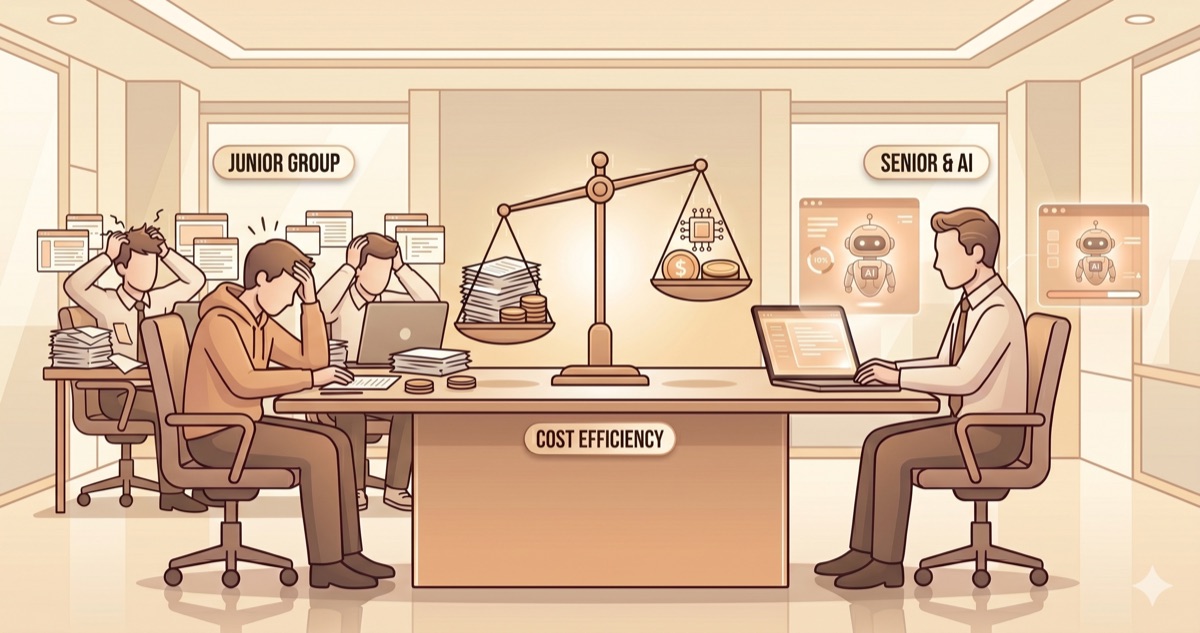
In a previous post, I discussed how AI inserted itself as an unexpected variable in the generational workplace debate. One concrete form of that variable is already taking shape: the senior part-time AI model. Instead of hiring three full-time juniors, companies bring in one experienced professional who leverages AI, working three days a week. Overseas, the concept already has a name.
Fractional Executives — This Is Already Happening
The most established version of the senior part-time AI model goes by "Fractional Executive." Instead of hiring a full-time CMO, CFO, or CTO, companies contract C-level talent for two or three days a week.
In the U.S., this has moved well past the experimental phase. Toptal's 2024 data shows freelance C-level demand grew 46% year over year. LinkedIn's 2024 "Future of Work" report found that about 64% of companies plan to increase their use of contract and part-time specialists over full-time hires.
Several structural forces drive this:
- Startups and mid-size firms can't afford full-time executive salaries
- Experienced professionals prefer portfolio careers over being locked into one company
- Remote work eroded the need for daily physical presence
- AI tools raised the ceiling on what one person can produce
That last point is the game-changer. Before AI, one person's output had a physical cap. That cap just moved significantly upward.
The Cost Math — Numbers Don't Lie
Here's a simplified comparison that applies across markets:
| Factor | 3 Full-Time Juniors | 1 Part-Time Senior + AI |
|---|---|---|
| Monthly labor cost | $9,000-12,000 total | $6,000-8,000 (3 days/week) |
| AI tool cost | None | $200-400/month |
| Onboarding period | 3-6 months (x3) | Effectively zero |
| Management overhead | Middle manager's time | Self-directed |
| Quality risk | Learning-curve errors | Experience-based judgment |
| Total monthly cost | $9,000-12,000 + hidden costs | ~$6,500-8,500 |
Reality is messier than any table. But the direction is clear. The gap is most pronounced in judgment-heavy work — strategy, architecture decisions, client-facing problems.
Beyond the Spreadsheet
Cost isn't the whole story. The time and energy a middle manager spends supervising three juniors rarely shows up in budget reports, but it's one of the biggest bottlenecks in practice. A part-time senior needs alignment on direction, then delivers results independently.
The Senior Part-Time AI Upside — The Professional's Perspective
This trend isn't one-sided. For experienced professionals, it's an attractive arrangement.
- Work three days a week, invest the rest in personal projects or learning
- Multiple clients mean diversified income — losing one contract doesn't mean losing everything
- Focus on your specialty instead of office politics and unnecessary meetings
- Experience becomes a premium, not a liability tied to age
As covered in our AI instructions guide series, professionals who configure AI to fit their workflow multiply their output. A 10-year veteran using AI effectively doesn't just become "efficient." They become a one-person department.
Companies Follow the Money
Let me be direct: I can't tell you this model will take over every industry. In many markets — especially those with strong full-time employment cultures like South Korea and Japan — there are real barriers. Face-time expectations, seniority systems, labor laws built around permanent positions.
But companies don't operate on tradition. They operate on returns.
- Roughly 40% of S&P 500 companies already use fractional talent in some capacity
- The global gig economy market is projected at approximately $556 billion in 2025
- AI tool costs keep dropping while senior professionals' AI fluency keeps rising
The math is moving in one direction. Culture will follow — it always does, eventually.
What About People in Their 20s?
If you're in your 20s reading this, some anxiety is natural. But panic would be premature.
The Replacement Risk — Real and Present
As the senior part-time AI model spreads, the first positions to shrink are the "time-filling without experience" roles. Repetitive tasks, instruction-following, draft reports — AI already handles these faster and more consistently than new hires.
The AI-Native Advantage — Genuine Opportunity
On the flip side, people in their 20s grew up with AI. While mid-career professionals learn AI as a new tool, younger workers used it for school assignments before they ever had a job. That familiarity is a long-term asset.
The key distinction: "I can use AI" is table stakes. "I use AI to produce results others can't" is the actual differentiator. Everyone can open the tool. Turning it into judgment, strategy, and creative output requires the kind of thinking that only develops through deliberate practice.
Where the Numbers Point
This isn't a prediction that senior part-time AI arrangements will replace all full-time jobs. It's not a claim that traditional employment is dying. What is undeniable is that companies now have options they didn't have three years ago.
Companies decide based on numbers, not feelings. Where those numbers point is something each of us has to evaluate for ourselves.