7 Common Mistakes That Ruin Your AI Instructions
The 7 most common mistakes people make when writing AI instructions, with Before/After examples. Fix your instructions and the same AI responds differently.
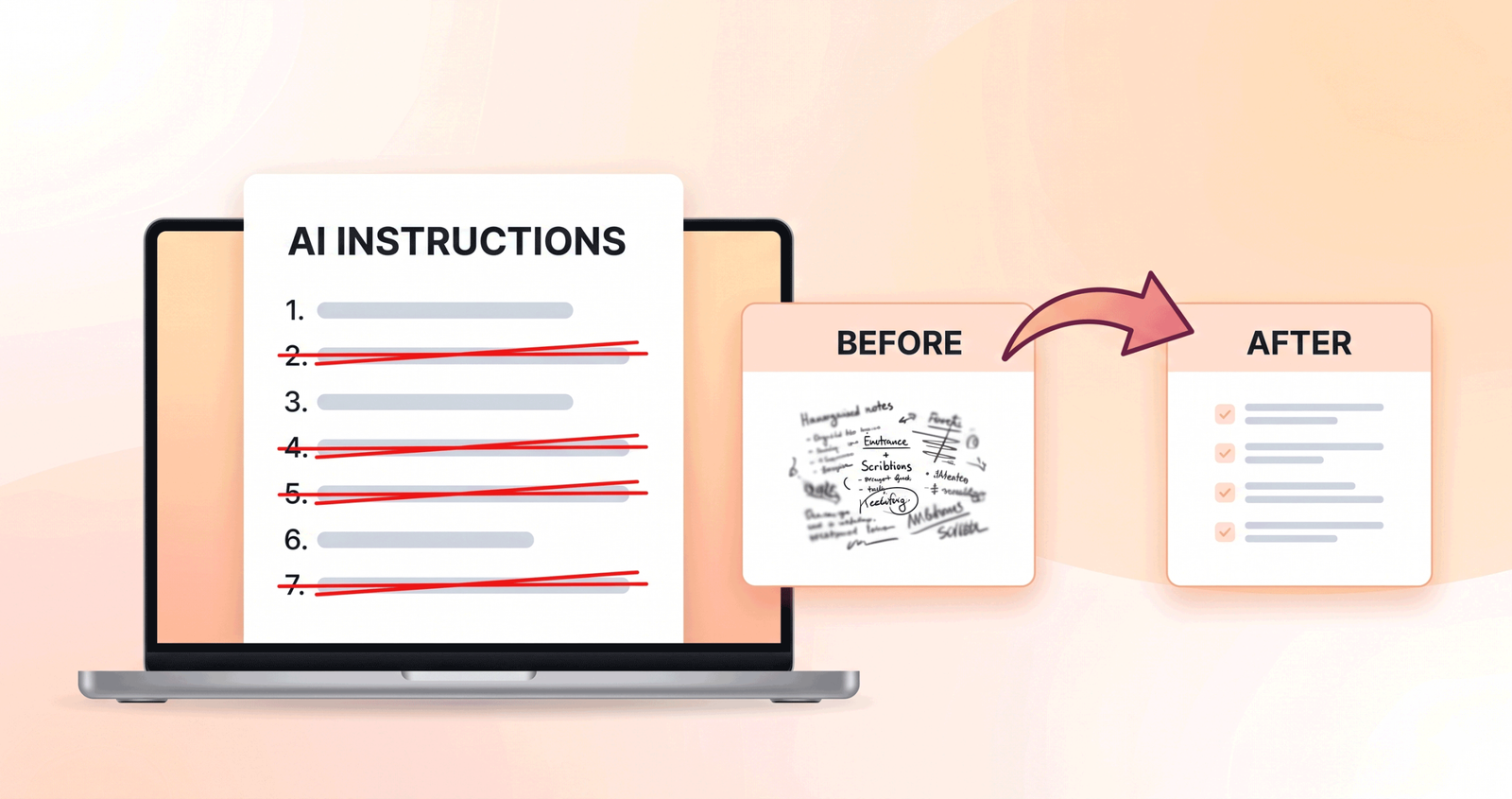
You wrote AI instructions carefully, but they don't seem to work. There's a good chance you're making one of these seven mistakes.
This guide collects the most common errors people make when writing AI instructions for the first time. Each mistake includes a Before/After example so you can check your own instructions.
Mistake 1 — Writing a Novel
Writing instructions as long, narrative paragraphs. The AI needs rules, not your life story.
Before:
I'm a project manager with about 5 years of experience, mainly working on B2B SaaS products. Recently my team has grown and I've started to realize the importance of documentation, so I want to write more structured reports. Previously I wrote them pretty freely but now I feel like I need a more organized format...
After:
Role: B2B SaaS PM (5 years) Goal: Structured reports Format: Conclusion → Evidence → Next steps
The AI only needs the key facts. One or two lines of background is enough.
Mistake 2 — Cramming Everything Into One File
Your instructions keep growing until one file hits 1,000 lines. The AI reads all of it, but rules near the bottom lose influence dramatically.
Before:
CLAUDE.md (87 lines)
- My role
- 23 writing style rules
- 15 formatting rules
- 12 constraints
- 20 reference links
- Project A rules
- Project B rules
- ...
After:
CLAUDE.md (15 lines) — core rules only docs/writing-rules.md — style and format details docs/project-a.md — Project A specific rules docs/project-b.md — Project B specific rules
Core rules stay in CLAUDE.md. Everything else goes into separate files.
Mistake 3 — Being Too Abstract
"Write well," "translate naturally," "format appropriately" — these instructions are practically useless. What counts as "good" or "natural" changes every time the AI interprets it.
Before:
Write in natural, flowing English.
After:
Tone: Professional but conversational. Sentences under 20 words. No filler phrases ("in order to," "it should be noted that").
Specific criteria and constraints leave less room for the AI to interpret differently each time.
Mistake 4 — No Examples
No matter how well you describe a rule, one example is more powerful. AI learns patterns more accurately from concrete examples than from abstract descriptions.
Before:
Use tables for comparisons.
After:
For comparisons, use this table format:
Item Pros Cons Best for A ... ... ...
When you show an example, the AI mirrors the column structure, alignment, and level of detail.
Mistake 5 — No Exceptions to Rules
"Always use formal tone" sounds clear, until the AI converts dialogue examples and UI text into formal language too. Absolute rules without exceptions produce unintended results.
Before:
Always use formal, professional tone.
After:
Default tone: Formal and professional. Exceptions: Dialogue examples, direct quotes, and UI text should keep their original tone.
Whenever you write "always" or "never," ask yourself if there are genuinely zero exceptions.
Mistake 6 — Write Once, Never Update
Instructions aren't a one-time task. Every time the AI responds differently than you expected, that's a signal to review and update your instructions. Just like debugging code.
Practical routine:
- The AI gives an unexpected response
- Ask yourself: "Why did it answer this way?"
- Check if your instructions cover that scenario
- If not, add a rule. If the rule exists but wasn't followed, make the wording clearer
Repeat this loop and your instructions become more precise over time. No one writes perfect instructions on the first try.
Mistake 7 — Not Stating Your Role
Skipping "who I am" is surprisingly common. The same question gets a completely different answer depending on whether you're a senior PM or a first-time coding student.
Before:
Write a report.
After:
Role: B2B SaaS PM (5 years). Audience: C-suite + dev team leads. Write a report.
One line of role context changes the depth, vocabulary, and explanation style of every response.
Mistake Checklist
Review your own instructions against this list.
| Check | Status |
|---|---|
| Is your role stated? | □ |
| Are core rules under 500 words? | □ |
| Are long instructions split into files? | □ |
| Do rules have specific criteria instead of vague adjectives? | □ |
| Is there at least one concrete example? | □ |
| Have "always/never" rules been checked for exceptions? | □ |
| Have you reviewed and updated instructions in the past week? | □ |
Wrapping Up
Most AI instruction mistakes come down to writing too much, too vaguely, and only once.
Write short. Write specific. Revise often. Follow these three principles and the same AI will follow your intent far more accurately. Perfect instructions don't come from a single writing session — they come from using them and refining as you go.