Ten Minutes Before, Ten Minutes After — AI Meeting Prep and Sharing Notes
The quality of meeting notes is decided before the meeting starts, not after it ends. How to feed context to AI in the ten minutes before, how to share by audience in the ten minutes after, and why you shouldn't react on the spot when a meeting makes you angry.
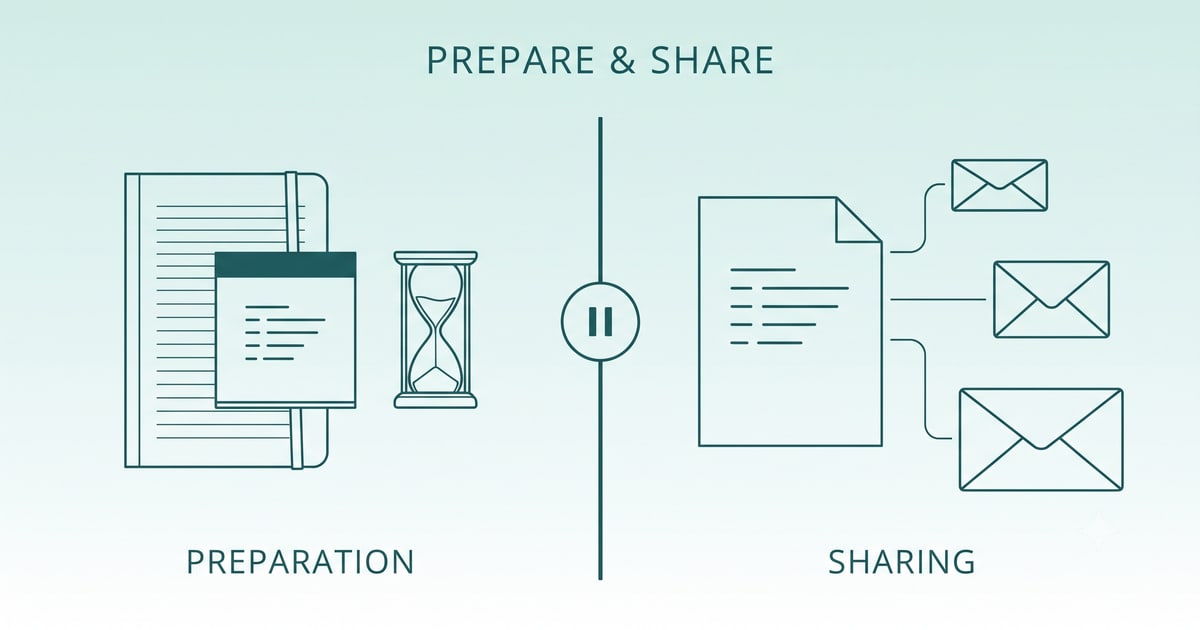
What separates people who write good meeting notes from people who don't isn't typing speed. It's what they knew walking in, and who they sent what to on the way out. Why dumping a full transcript into an AI breaks down is covered in an earlier post; this one fills in the before and after.
AI meeting prep is not pasting the agenda into a chat. It's loading, ahead of time, what the AI will need to already know when the meeting ends. Ten minutes before, ten minutes after — and the emotional problem that wedges itself in between, which derails more work than either of the other two.
Ten Minutes Before — Load Context, Not the Agenda
Hand an AI a transcript after the fact and it meets the context for the first time right there. It doesn't know what got deferred last month or who actually holds the decision in the room, so the summary comes back full of phrases like "the team discussed."
A five-line pre-brief
Five lines before the meeting starts. It doesn't need to be elaborate.
Topic: finalize scope of the payment module replacement Attending: 2 product, 3 engineering, 1 operations (decision sits with the ops lead) Last meeting decided: phase 1 is test payments only; live payments deferred Must leave with: the live-payment cutover date, and who owns rollback Do not include: customer names, contract amounts
That last line matters most. Deciding up front what stays out means one less judgment call mid-meeting.
Pull the questions you'd miss
Feed in the brief and ask this, and you'll have fewer "I forgot to ask that" moments afterward.
I'm walking into this meeting. Give me three points where a decision is likely to slip, and five questions I'd probably fail to ask. Questions only — don't answer them.
You're not after answers. You're after a checklist. Keeping that list beside you during the meeting is most of what puts you on the savvy side of the room.
Ten Minutes After — Notes Aren't Notes Until They're Read
A finished set of notes isn't notes yet. It becomes notes when someone reads it. And attendees, absentees, and decision-makers open the same document looking for different things.
| Reader | Needs first | Can skip |
|---|---|---|
| Attendees | Action items with their name and a date | The discussion recap — they were there |
| Absentees | What was decided and what changed | Speaker-by-speaker detail |
| Decision-makers | What's deferred and what's blocked | Items already agreed |
So four blocks are enough: Decisions / Action items (owner, date) / Deferred / To confirm next. In that order, every reader finds their own line first.
Three rules go with it.
- Send within 24 hours. Notes that arrive three days later are a record, not a handoff.
- One destination. Post them to chat and email them and nobody knows which copy is current after the first correction.
- Keep irreversible decisions somewhere else too. Notes scroll away; decisions shouldn't. That's what a decision record is for.
Don't React on the Spot — When a Meeting Makes You Angry
Meetings produce moments that make you angry. A request lands casually outside the agreed scope, you get grilled over something already closed, or your call gets reversed in front of everyone. And when "if that's how it's going to be, we're not doing it" leaves your mouth in the room, the next meeting isn't about the agenda. It's about that sentence.
The problem isn't that the sentence was wrong. The problem is that on reflection, the other side's demand is often legitimate. Anger usually attaches to how something was said or when it landed, not to what was actually asked. If the tone was the issue but the request itself was reasonable, one sharp line in the room makes that reasonable request much harder to revisit.
One thing helps here: the anger may not be about the meeting. Recovery programs have used a self-check called HALT for decades — when you're Hungry, Angry, Lonely, or Tired, your judgment isn't where it usually is, so postpone anything important. It isn't a diagnostic tool, but if you've ever noticed yourself unusually sharp in a 4 p.m. meeting on a day you skipped lunch, you know the shape of it. Sleep debt, hormonal cycles, or plain depleted energy changing the volume of an emotion is not unusual.
So there's one rule. In the room, you only take it down. "Let me check and come back to you today" gets you out of the moment, and you sort it out in between.
Below is a request I just received in a meeting. Strip the emotional language and list the requirements as items. For each item, give me one line on what legitimate reasoning the other side might have, and one line on what accepting it costs us. Don't take my side.
That last line is the important one. Ask an AI anything while you're angry and it will usually agree with you, which feels good and does nothing for the meeting. The reason to use AI here isn't a better sentence. It's to borrow a calm state for a minute. Knowing you aren't calm doesn't make you calm, but you can still read what the calm version would have written.
And if something survives that pass, it doesn't belong in the notes. It's a conversation to have with the person directly. Notes carry what the room agreed on — a line like "blocked again because so-and-so objected" feels factual while you're typing it and reads as a verdict to everyone else.
Before It Goes Into an External Tool — A Three-Line Check
Meeting notes are where personal data and confidential terms mix most easily, and auto-transcription made that worse.
- Do the attendees know they're being recorded? A recording nobody consented to is already a problem before any tool touches it.
- Are names, contacts, and contract terms going in verbatim? Replacing them with roles ("the ops lead") barely costs you any summary quality.
- Does the tool train on your input? Company policy comes first if you have one; if you don't, the default is "only sentences that could survive leaving the building."
Tool settings change. Those three lines don't. If you keep an instruction file, put them in it once and stop re-deciding.
Wrapping Up
- The quality of your notes is set in the ten minutes before the meeting. Not the agenda — the context: last decisions, who decides, what you must leave with, what stays out.
- Different readers want different things. Decisions / action items / deferred / to confirm, sent within 24 hours to one place.
- When a meeting makes you angry, take it down and say you'll come back. On reflection the demand is often legitimate, and the anger may be about your body rather than the meeting. Use AI to borrow a calm state, not to get a nicer sentence.
Reference: The HALT practice explained