Codex vs Claude Code for Korean Developers — Encoding, Performance, and Which to Choose
Comparing Codex and Claude Code from a Korean developer’s perspective. Encoding, performance benchmarks, pricing, and when to use which.
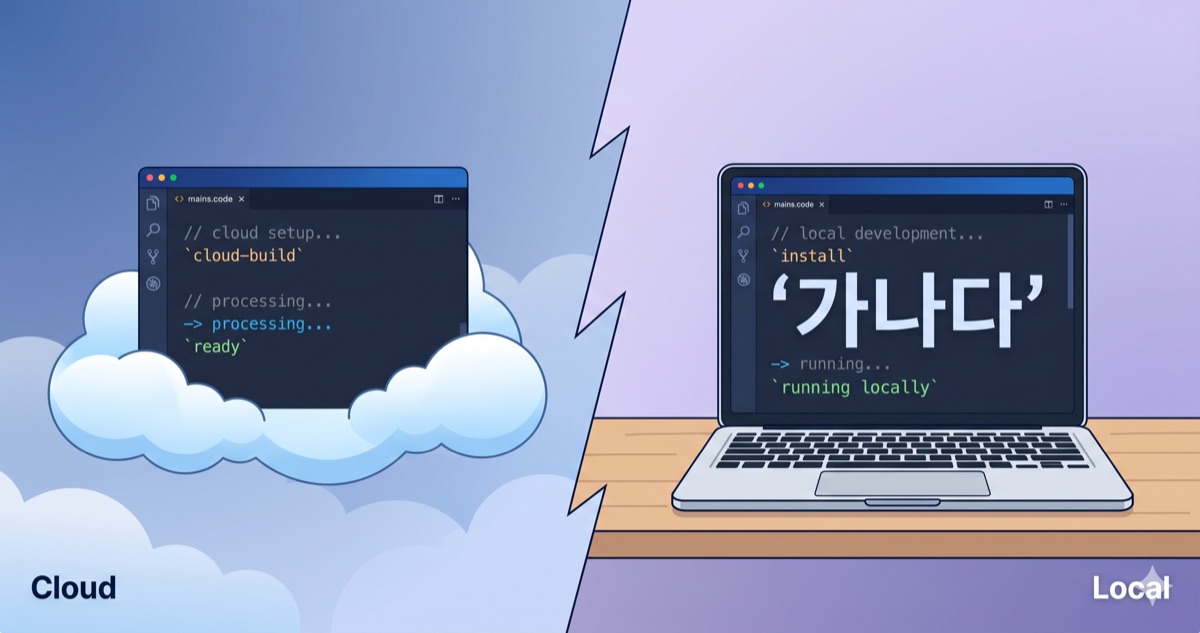
Codex vs Claude Code — if you work with Korean text in your codebase, this comparison matters more than any benchmark score. Both tools are powerful AI coding agents, but they handle non-ASCII text very differently. This guide breaks down the practical differences for developers who deal with Korean filenames, comments, and legacy encodings daily.
Architecture — Cloud Sandbox vs Local Terminal
The fundamental difference between Codex vs Claude Code is where your code runs.
Codex operates in a cloud sandbox. When you submit a task, OpenAI spins up an isolated container that reads, modifies, and tests your code on their servers. It's asynchronous — you fire off a request and come back later for results. The tradeoff is that your repository needs to be uploaded first, and the sandbox environment is locked to specific configurations.
Claude Code runs directly in your local terminal. It reads and writes files on your machine, executes shell commands, and gives you real-time interactive feedback. This makes it ideal for debugging sessions and exploratory work where you need immediate responses.
| Aspect | Codex | Claude Code |
|---|---|---|
| Execution | Cloud sandbox (async) | Local terminal (interactive) |
| File access | Requires repo upload | Direct local filesystem |
| Networking | Limited in sandbox | Unrestricted |
| Parallel tasks | Multiple concurrent tasks | Single focused session |
Codex vs Claude Code — Korean Text Handling
This is the make-or-break difference for Korean developers.
Codex has documented issues with Korean string handling. As a previous post covered, the cloud sandbox locks its locale to en_US.UTF-8, which causes Korean filenames to break and EUC-KR encoded files to be misread. Unicode normalization mismatches appear when the sandbox uses os.listdir() on directories containing Hangul characters.
Claude Code sidesteps this entirely because it runs locally. If your machine's locale is set to ko_KR.UTF-8 (or any UTF-8 locale), Korean filenames, comments, and multi-byte strings work natively. No extra configuration, no workarounds.
EUC-KR Legacy Code
Many Korean enterprises still maintain codebases encoded in EUC-KR. Codex's sandbox only recognizes UTF-8 by default, so opening EUC-KR files produces garbled text. Claude Code can leverage local tools like iconv or editor configurations for seamless encoding conversion.
Benchmarks — Performance by the Numbers
Public benchmarks tell different stories depending on the task type.
| Benchmark | Codex | Claude Code | What it measures |
|---|---|---|---|
| SWE-bench Verified | Limited public data | 80.8% | Real GitHub issue resolution |
| Terminal-Bench | 75.1% | 65.4% | Terminal-based system tasks |
| HumanEval | High (GPT-4.1 based) | High (Sonnet 4 based) | Code generation accuracy |
Claude Code's 80.8% on SWE-bench signals strong performance on real-world software engineering tasks — the kind of work that involves understanding existing codebases, diagnosing bugs, and writing targeted fixes. Codex leads on Terminal-Bench at 75.1%, suggesting advantages in system administration and infrastructure tasks.
What the Numbers Don't Show
Benchmarks measure isolated tasks, not real workflow comfort. Neither benchmark captures how well a tool handles Korean filenames, incremental debugging, or the back-and-forth of "try this, now try that" exploration. Keep the numbers in context — they're data points, not verdicts.
Pricing — Subscription vs Token-Based
Codex comes bundled with ChatGPT Pro ($200/month) or Plus ($20/month). At the Plus tier, $20/month gives you substantial token usage — solid value for individual developers.
Claude Code uses API token-based pricing. You can also access it through the Max plan ($100 or $200/month). Complex tasks can burn through tens of thousands of tokens in a single session, so costs can escalate quickly.
| Aspect | Codex | Claude Code |
|---|---|---|
| Base cost | $20/mo (Plus) | Pay-per-token (API) or Max $100–200/mo |
| Token efficiency | Included in subscription | High per-session consumption |
| Free trial | Available within Plus | Limited |
Project Instructions — CLAUDE.md vs AGENTS.md
Claude Code uses a CLAUDE.md file to manage project rules. Coding style, forbidden patterns, architecture decisions — write them once, and every session automatically references them. The AI instructions series covers this in depth.
Codex uses AGENTS.md files and repository settings to pass instructions. Its tight GitHub integration makes it natural for PR-based workflows.
| Aspect | Claude Code | Codex |
|---|---|---|
| Instruction file | CLAUDE.md | AGENTS.md |
| Scope | Project-wide + subdirectory overrides | Repository-wide |
| Auto-loading | On session start | On task start |
| Hierarchy | Root + subdirectory layers | Root + directory-level |
When to Use Which — Decision Guide
The right choice between Codex vs Claude Code depends on your workflow and environment.
| Scenario | Recommended | Why |
|---|---|---|
| Projects with Korean filenames/comments | Claude Code | Native local locale, zero encoding issues |
| GitHub PR-based collaboration | Codex | GitHub integration, async task model |
| Real-time debugging and exploration | Claude Code | Interactive, immediate feedback |
| Parallel large-scale refactoring | Codex | Async parallel processing |
| EUC-KR legacy codebases | Claude Code | Local encoding tools available |
| Budget-conscious solo projects | Codex (Plus) | $20/mo flat rate |
The Hybrid Approach
In practice, you don't have to pick just one. A hybrid workflow leverages each tool's strengths.
- Exploration and design phase: Use Claude Code locally to analyze code and discuss architecture decisions interactively
- Implementation and PR phase: Hand off implementation tasks to Codex for async PR generation
- Korean-specific work: Handle directly in Claude Code to avoid encoding headaches
For official documentation, see OpenAI Codex CLI and Claude Code Docs.
Codex vs Claude Code isn't about declaring a winner. It's about matching the right tool to the right task. If encoding stability with Korean text is non-negotiable, Claude Code is the safer bet today. If async task processing and GitHub integration are your priorities, Codex's architecture has clear advantages. Combine both, and you get a workflow that's greater than the sum of its parts.