Teaching New Hires AI — Why the First Month Decides How They Work for Life
Teaching new hires AI is less about the tool than the habit they form in the first month. Three habits that stick for life, and the signs a manager should catch early.
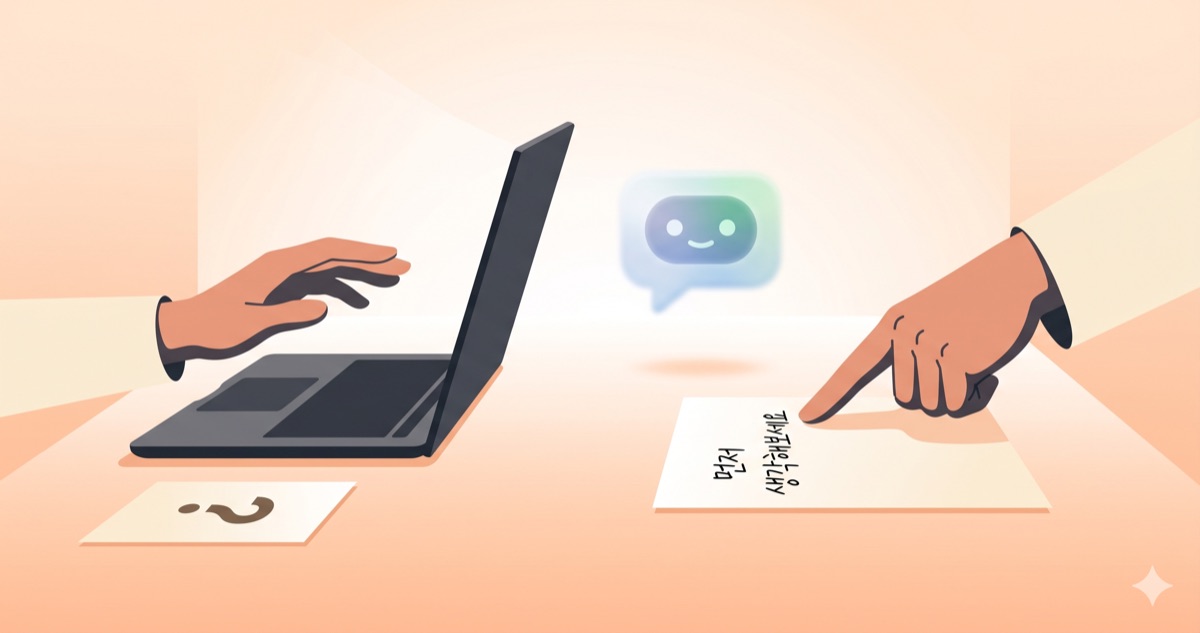
Honestly, we didn't hire a single new graduate this year. What we did get were two colleagues reassigned from a dissolved team. They had company tenure, but in our team's domain they were starting from zero — effectively new hires. I watched both of them open an AI tool for the first time. One pasted the day's entire task into the chatbot the moment the screen lit up. The other read the task, ran it through their own head once, and then asked the chatbot only about the part that was actually stuck. A month later, the gap between how they worked was wider than I could close.
Teaching new hires AI is less about teaching them the tool than about teaching them the habit of passing the task through their own head before reaching the AI. That habit is decided in the first month, and once that month passes, it gets very hard to undo.
Two Patterns I Saw in the First Week
When a new hire opens an AI tool for the first time, the manager can read the signal almost immediately. There are two patterns.
- "Hand it all to the AI" pattern — The task arrives, they paste it straight into the chatbot. There's no hypothesis of their own, and the AI's answer becomes the deliverable.
- "Use AI as a tool" pattern — They read the task once, organize it in their own head, and only the stuck or uncertain part gets sliced out and sent to AI.
The reason two people split this cleanly on day one is simple. It comes down to whether the task ran through their own head before meeting the AI. Without a manager's deliberate teaching, most new hires settle into the first pattern. It's faster, the result comes up right away, and it hides any gap in their own understanding.
Three Bad First Habits
These are the three habits new hires fall into most often if no one intervenes.
1. Throwing the Whole Task at the AI
The task is copied and pasted verbatim. There's no checkpoint where the new hire reads the task and decides how they'd approach it. If the AI's answer looks plausible, it's submitted. The fastest output — but nothing about the task leaves a trace in the new hire's head.
2. Accepting the Answer Without Verification
The numbers, citations, sources, and code that the AI produces are trusted as-is. Not a single line is double-checked, because well-written prose feels like truth. The accidents this leads to usually surface around month six — and by then the habit is already set.
3. Memorizing Prompts Instead of Reasoning
They memorize "for this kind of task, use this prompt." They don't know why the prompt works, and when it doesn't they can't adapt it. You can memorize the shape of a good prompt, but you can't memorize the thinking that produced that shape.
Why the First Month Decides
A joint study from Microsoft Research and Carnegie Mellon University found that knowledge workers who are confident in their tasks tend to think critically about AI output, while those who lack that confidence tend to accept AI responses as sufficient. The same study describes how the effort people invest shifts under AI use — "from information gathering to information verification, from problem-solving to AI response integration, from task execution to task stewardship."
The point lands plainly. Critical scrutiny of AI output requires confidence, and a new hire is — by definition — short on confidence. Accepting AI answers without question is the new hire's default state. If a manager doesn't break that default in the first month, the new hire will still be in that same default six months and a year later.
One thing worth marking here: the "new hire" in this post isn't only someone who entered through the hiring funnel. It also includes colleagues who were reassigned by reorgs and are effectively starting from zero in a new domain. That second group is taking up an increasing share of who managers actually teach. They have company experience, but their confidence in the new work is at new-hire levels, which means their default critical-scrutiny muscle around AI output is just as weak.
Teaching New Hires AI — Three Principles
These are the three things I repeat over and over during a new hire's first month to keep them out of the three bad habits above.
1. Write a Hypothesis Before Asking the AI
Before the AI is queried, have them write a one-line restatement of the task and a one-line hypothesis. The hypothesis can be wrong. The point is that the task has passed through their own head once before the AI's answer arrives. With a hypothesis on the table, the AI's answer gets compared to it — and that comparison is where critical thinking starts.
2. Ask "Why Is This Right?" Once
When the AI returns an answer, make them ask, on the spot, "why is this correct?" It can be a follow-up question to the AI itself, or a quick written checklist on their side. Having this one round vs. not having it shows up as a difference in work judgment six months later.
3. Solve a Small Task Without AI Each Week
Once a week, turn the AI off and have them solve something on their own. A short analysis, a short piece of writing, a small judgment call — anything small. The sense that they could still solve a problem without AI has to stay alive, because that sense is what lets them treat AI as a tool when it's on. Once that sense dies, it's very hard to revive.
Two Questions a Manager Can Ask
To know whether you're actually teaching the three principles above, you only need two questions when reviewing a new hire's work in the first month.
- "How did you approach this?" — In one or two sentences, you hear whether they had a hypothesis and how they used AI.
- "How did you confirm the AI's answer?" — You hear immediately whether they verified or just accepted.
If those questions get smooth answers, they're inside the right pattern. If the answers stall, you have one or two more rounds of teaching to do. The answer a manager needs to hear isn't the correct one — it's a short trace that the task ran through the new hire's own head once.
The First Month Doesn't Come Back
In the third post, I wrote that the answer to delegating to new hires is being rewritten in the AI era. This post is one fragment of that rewrite. Even if you delegate the day-to-day pairing to a peer, teaching AI is one part that — for now — I believe the manager has to run directly in the first month.
In the first and second posts, I wrote that certain managerial decisions only become visible after you've actually sat in the chair. Teaching new hires AI is one of those areas a manager's role has to absorb, and it differs from the others in one respect. If you miss the first month, the new hire's whole way of working sets. Of the scenes a manager has to walk through, this is the one with the shortest window for recovery.
So this post isn't a guide to showing new hires the tool. It's closer to a note on how a manager plants the habit of passing the task through one's own head before the AI is reached. Tools change every year. The habit of running the task through your own head once carries forward, regardless of which tool is loaded. Planting that habit in the first month is, for now, about half of what teaching new hires AI even means.
The "fresh new hires" managers actually meet these days aren't only the ones who came in through hiring — colleagues reassigned from dissolved teams can make up a substantial share too. New-hire pipelines are thinning while reorgs continue, so there's a fair chance the same teaching gets repeated to a different colleague more often than not. I hope this post turns out to be a short memo you can pull out in those moments.