Delegating to New Hires — Four Methods, and Why ‘Just Trust Them’ Fails Most Often
There are four ways to delegate to a new hire, and the most popular one — ‘just trust them’ — fails most often. A mid-career manager’s honest take on why even pairing rarely survives a real schedule.
📖 40-Something Manager Field Notes — View All Part 1: What Becoming a Manager Revealed — ‘So That’s Why My Boss Did That’ Part 2: My First 1on1 Failed — Why the Manual Doesn’t Work, and the 5 Principles I Use Instead ▶ Part 3: Delegating to New Hires — Four Methods, and Why ‘Just Trust Them’ Fails Most Often (this post) Part 4: Teaching New Hires AI — Why the First Month Decides How They Work for Life Part 5: Deadline Negotiation — 3 Sentences to Use Instead of ‘I Can’t’ Part 6: Salary Negotiation — Three Variables Bigger Than the Amount
Delegating to new hires sounds like the simplest topic in management writing — and “just trust them and let them run with it” is the answer most books default to. The line doesn’t sound top-down, it gives off a generous trust-them-to-grow vibe. But when you apply the same line to an actual new hire, it fails — often.
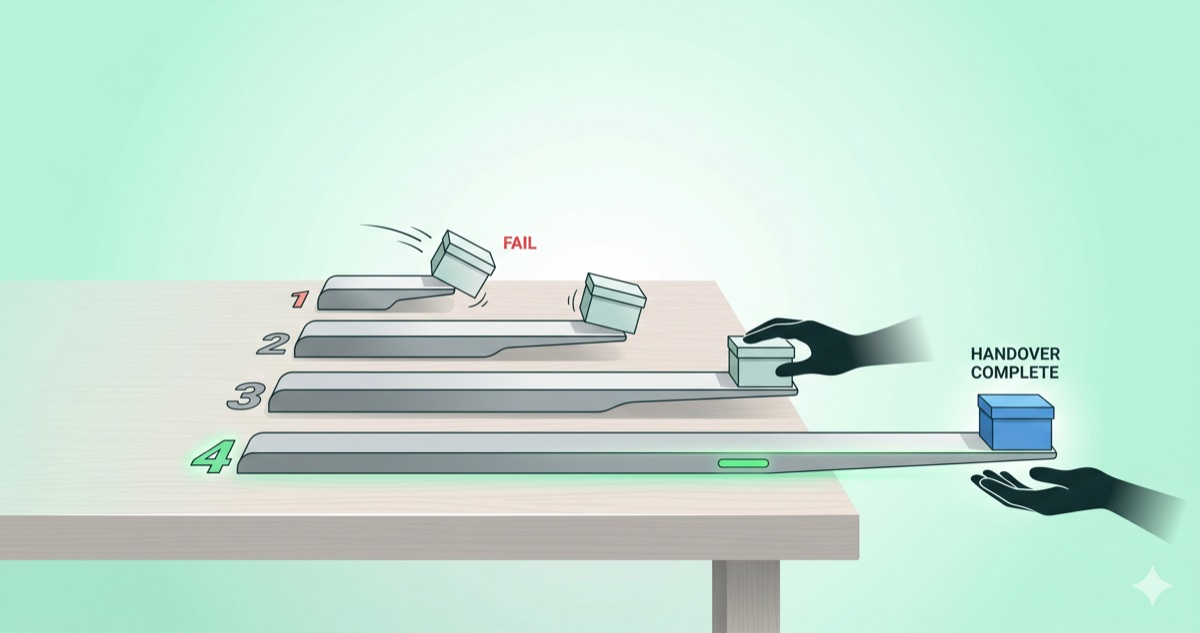
Delegating to new hires really comes down to four methods. Each one only works in a specific seat. The most popular method fails the most often, and the most effective one turns out to be something a manager can rarely run themselves. That second part isn’t in most books, and that’s where I want to start.
Delegating to New Hires — What My First Hire Taught Me
The first time I onboarded a new hire, I followed the playbook: “Take a swing at it — ask if you get stuck.” A week later, the work came back pointing in a completely different direction. I could picture what that week had been like on the other side. Without a sense of the path, asking gets harder, not easier. “Ask if you get stuck” is a line that only works among people who already know the route.
With the next new hire, I went the opposite way — every step pre-cut and handed over. Output came out fast. But six months later, when I tried something similar, I had to pre-cut everything all over again. That hire did the work but never grew into it.
These swings led me to map out the four methods.
Four Ways to Delegate to a New Hire
1. Hand It Over Completely — “Take a swing at it”
The most popular and the most reliable way to fail. The manager believes they’ve extended trust. The new hire reads it as “I have no idea which direction, and asking feels heavy.” That’s the fastest route from intended trust to felt pressure. This method only works with someone who already knows the road. It gets used on new hires because it sounds generous.
2. Pre-Cut Everything — “Do this, this, and this”
The manager slices the work and hands it across. Hands move fast. The new hire never wanders. The new hire also never grows. Six months later, the same task still requires the manager to slice it again. Fine for short or urgent work; ruinous as a default.
3. Break It Into Checkpoints — “Show me a milestone every week”
The work is split into big chunks, but the steps inside each chunk belong to the new hire. “Show me the first third by next Wednesday.” The new hire moves at their own pace; the manager catches drift early. Light questions surface on the spot, heavy problems show up within a week. This is the right default after the new hire is settled.
4. Work Beside Them — “Pair for the first month”
In theory, this is the most effective method. A manager or a senior pairs with the new hire — pair-programming for code, joint editing for documents, sitting in on meetings together. By the end of the first month, the new hire absorbs how the team actually solves problems. That sense carries the next five months. The catch — which I’ll get to in a moment — is that running method four directly, as a manager, almost never happens in real life.
Manager Time vs New-Hire Growth
The four methods trade off in a fairly clean way.
| Method | Manager time | New-hire growth | Right setting |
|---|---|---|---|
| 1. Hand it over completely | Low (cleanup cost high) | ❌ Trust becomes pressure | Almost never — experienced hires only |
| 2. Pre-cut everything | Low | ❌ Frozen | Short / urgent tasks only |
| 3. Checkpoints | Moderate | ✅ Steady | Default after onboarding |
| 4. Work beside them | Heaviest time investment | ✅ Explosive | First month (in theory) |
The table says one thing plainly: if you don’t spend the time, the new hire doesn’t grow. The real question is whether that “heaviest time investment” can actually come out of the manager’s calendar.
You Can’t Actually Spend That Time
Honestly, a manager rarely runs method four directly for a full month. The calendar is already shaved thin by 1on1s, meetings to push through, decisions to chase upstairs. There’s no untouched month sitting there for pairing with one new hire.
And there’s a second honest piece. When new hires leave after one month, then two months, again and again, a manager goes hollow. When you’ve sliced your own time to pour into that seat, the next time you have to do it, your body starts pulling back before your head agrees. You begin to avoid being deep in the new-hire seat. That isn’t a character flaw — it’s the natural reaction of a finite calendar after a few losses.
So Most Teams Delegate the Pairing to a Peer
The variation that actually works in practice is pairing the new hire with a peer one or two levels up — a mid-level associate, a junior senior. Work is divided into handoff form for a month or two. The manager doesn’t pair; the manager watches the pairing run from a distance. With this swap, method four can survive a real schedule.
The upside is clear. The manager’s time is distributed across the team. The new hire gets a mentor close to their own seat, which makes asking a lighter act. Closer distance, lighter weight.
The Peer-Pair Trap — You Lose Sight of Who Can Actually Do the Work
The biggest trap here is that, by the time probation ends, the manager can’t honestly say whether the new hire has the instincts for the work. The peer doing the pairing is in a helping posture — naturally surfacing the better moments first. The manager is one step removed and misses the texture. From a distance, “they seem to follow well” is the impression that lands most often.
Then probation closes. The most painful version is when the gap in instincts becomes visible only after you’ve already converted the hire. From that point, that seat is a long-term cost on the team. This is the failure mode managers who rely on peer-pairing miss most often.
The fix takes one more thing from the manager: even while the peer-pairing runs, the manager keeps short, direct review sessions with the new hire. Not 1on1s — short work reviews to read the instincts. If 30 minutes feels heavy, even 10-minute output reviews count. Delegate the pairing, but never delegate the read on the work.
A Mix by Phase
No single method is the answer; you mix them by phase. Roughly what I run now:
- First month: Mostly method 4, peer-paired. Manager watches from a distance, plus short direct reviews with the new hire on the side
- Months 2–3: Shift to method 3 (checkpoints) — weekly milestones
- Month 4 onward: Method 3 as the default, method 2 only when the work is urgent
- Method 1 (hand it over completely) almost never — perhaps after six months for someone who’s clearly grown
BambooHR’s Winning the First 90 Days reports that 70% of new hires decide whether the company is the right fit within the first month, and estimates the average window a company has to influence retention at 44 days. Gallup’s research finds that 89% of new hires who received effective onboarding end up highly engaged. The numbers point at the same conclusion. The first month decides. What’s rarely written down is that a single manager can’t carry that first month alone.
And — Still Looking for the Answer
In my first post, I wrote about scenery that only becomes visible from the manager’s chair. In the second, I described how a 1on1 manual eventually shrinks down to five lines on the corner of a desk. This piece is about one seat those five lines don’t cover — the new hire’s first month.
What I described above is how I run this now. Honestly, I’m not sure this version survives the next year. AI is reshaping where the work lives, how it gets done, and even how it’s handed off. Tasks that an associate used to teach a new hire through pairing are increasingly tasks that AI completes in a single pass. Handoff documents are becoming bundles of prompts.
So, honestly, I’m rethinking how to give work to a new hire when one arrives. I wrote that peer-pairing is the practical form of method four — but if the peer’s work itself moves to AI, the definition of “pairing” has to be rewritten. So does “reading instincts.” A new hire well-supported by AI and a new hire who stalls without AI can look identical at the output layer, which is exactly where evaluation usually happens.
I’m not claiming the four methods or the peer-pair trap are an answer. They’re the tools I happen to be holding right now. By the time the next new hire arrives, half of these tools may have shifted again. Delegating to new hires is starting to look less like a manager’s puzzle and more like a piece of how the whole team works with AI. I’m still looking for that answer too.