Deadline Negotiation — 3 Sentences to Use Instead of ‘I Can’t
Deadline negotiation collapses the moment you say ‘I can’t.’ Three sentences that keep the conversation open, the Iron Triangle behind them, and a short prep checklist.
📖 40-Something Manager Field Notes — View All Part 1: What Becoming a Manager Revealed — ‘So That’s Why My Boss Did That’ Part 2: My First 1on1 Failed — Why the Manual Doesn’t Work, and the 5 Principles I Use Instead Part 3: Delegating to New Hires — Four Methods, and Why ‘Just Trust Them’ Fails Most Often Part 4: Teaching New Hires AI — Why the First Month Decides How They Work for Life ▶ Part 5: Deadline Negotiation — 3 Sentences to Use Instead of ‘I Can’t’ (this post) Part 6: Salary Negotiation — Three Variables Bigger Than the Amount
“I can’t” is the weakest refusal in a deadline negotiation. It’s short, it’s clear, and that’s exactly the problem — it carries the least information of any answer you could give. The other side has to guess what’s behind that “I can’t,” and the guesses usually run in the worst direction. They don’t want to. They can’t plan their schedule. Let’s not give them the next one.
The way to lose less and keep more inside a deadline negotiation is to swap “I can’t” for three short sentences. None of them are hard to say, but in the actual moment they rarely surface on their own. Worth keeping them in the kind of note you can pull out before the conversation.
Why ‘I Can’t’ Fails Every Deadline Negotiation
The three pieces of information “I can’t” most often drops are these:
- What you can’t do (all of it, or just part)
- Why you can’t (time, resources, or priorities)
- What would have to change for it to be possible (the actual negotiable variable)
Without those three, the other side can’t make a decision, and that’s the whole point of the conversation. So when someone gets “I can’t,” they usually go in one of two directions — they push harder, or they quietly exclude you from the next round. Neither outcome makes you look better.
On the other hand, a refusal that names the variable that could change ends up at the same destination (“not this week”) without burning the relationship. That’s where deadline negotiation actually starts.
Three Sentences to Use Instead of ‘I Can’t’
All three have the same skeleton: “As-is, this won’t work → but if X changes, here’s what I can hold.” Only the variable that changes differs — scope, schedule, or priorities.
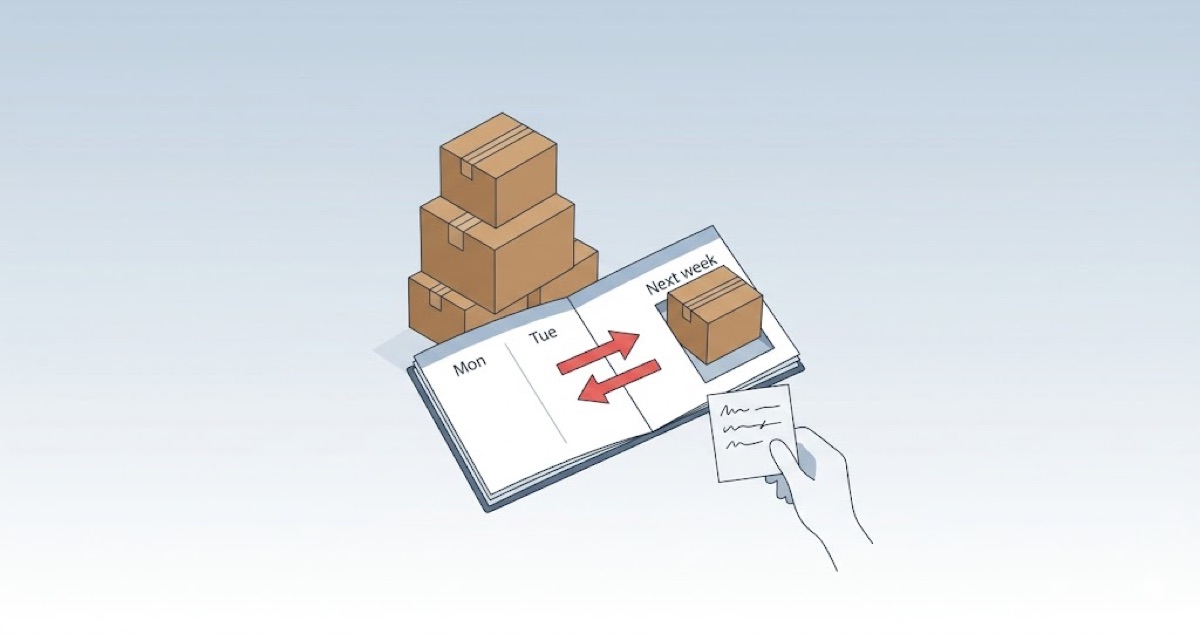
1. Scope / Schedule Trade — “I can hold X. For Y, I need Z extra days or to drop part of it”
The most-used sentence. You accept part of the ask and put scope or the date on the table as the negotiable variable.
“1 and 2 are workable by Friday. For 3 to ship with them, I’d need until next Tuesday — or, if □□ is dropped from 3, that’s a date I can hold.”
The point is to bring a number and an option together. Not “I need more time” but “I need X more days.” Not “the whole thing is hard” but “if □□ is dropped, the date holds.” Numbers open the negotiation. Without them, the negotiation doesn’t start.
2. Priority Question — “This conflicts with another priority. Which one moves back?”
Use this when several requests are landing on top of each other. The power of this sentence is that it hands the decision back to the person on the other side.
“If this lands while A is still in flight, both slip. Which one should I put first?”
The receiver of that question has three options — push A back, push the new one back, or add resources. Any answer they give is a workable answer for you. Surfacing the conflict is half the negotiation; the decision belongs to the person who can actually see across both items.
3. Phased Delivery — “Half this week, the rest next week — that’s a workable split”
For situations where you can’t push the deadline as a whole. You break the deliverable into parts and offer to ship the first piece on time.
“Shipping the whole thing this week isn’t workable, but I can hit the core (phase 1) by Thursday and the rest (phase 2) by next Wednesday. You also get to review phase 1 before phase 2 locks direction, which often helps the final quality.”
When a deadline is going to slip, what the other side fears most isn’t the slip itself — it’s the “deadline plus nothing arrives” scenario. Saying you’ll send a partial result first directly shrinks that fear. Same lateness, different felt weight.
The Common Structure — The Iron Triangle
The classic project-management Iron Triangle — Scope, Schedule, Resources — sits underneath every deadline negotiation. To actually negotiate, at least one of the three has to be put on the table as the movable variable.
| Sentence | Variable on the table |
|---|---|
| 1. “I can hold X. For Y, I need Z more days or to drop □□” | Scope or Schedule |
| 2. “Conflicts with another priority — which one moves back?” | Resource / time allocation |
| 3. “Half this week, the rest next week” | Scope, phased |
“I can’t” puts none of those three on the table. That’s why it can’t start a negotiation — the other side has no variable to negotiate against. Surface any one of the three and the other side picks up a real variable and steps into the conversation.
Short Prep Before the Conversation
For those three sentences to surface naturally in the actual moment, a small amount of prep beforehand goes a long way. Three things to know about your own work in advance:
- The volume and deadlines of what you’re currently running — can you summarize it in one line?
- Where in the new request can you draw a cut line or push the date?
- When something else lands on top of this, who actually decides the priority?
If those three are unclear, no negotiation sentence will hold up. The moment of negotiation isn’t where deadline negotiation usually fails — it’s the absence of that prep before you walked in. The conversation starts before the conversation.
After the Negotiation — Holding the Date You Offered Builds the Next One
Even if the three sentences land in the moment, missing the date you offered will burn the same card the second time. Negotiation isn’t a single conversation; it’s a relationship that compounds.
Sentences 1 and 3 (“if Y is dropped, that’s a date I can hold” / “half this week”) carry real weight in what you put on the table. The date you offer is the date you have to hit. So in the moment, only put forward dates you can hit without flinching. A good negotiator isn’t the person who puts the most options on the table — it’s the one who actually hits what they put there.
One More Sentence Beyond ‘I Can’t’
In the first post, I wrote about the scenery that only becomes visible after you’ve sat in the manager’s chair. Deadline negotiation is one of those scenes. As a junior, you spend time figuring out how to say “I can’t” more politely. After sitting in the chair, you spend time finding entirely different sentences instead of “I can’t.”
The three sentences aren’t a universal answer. But getting into the habit of giving one sentence longer than “I can’t” — visibly cuts the cost you carry out of any negotiation. A refusal with one extra line of information lets the other side make their next decision, and that’s why deadline negotiation, in the end, comes down to trust. That’s how I’ve come to think of it for now.