AI Replaces Tasks, Not Jobs — The Real Difference Between Those Who Survive and Those Who Don’t
AI will displace 92M jobs but create 170M new ones. The real question isn’t whether your job disappears — it’s which of your tasks get automated. Data-driven analysis.
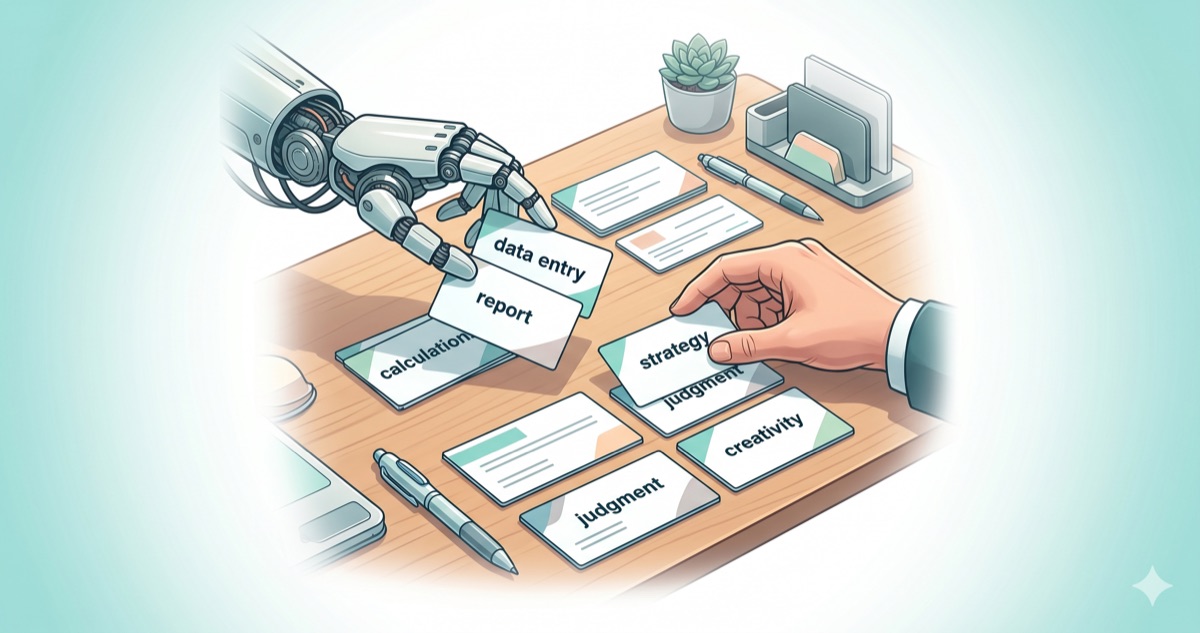
Every time AI and jobs come up, the conversation splits into two camps: the doomsayers who insist everything will be automated, and the optimists who wave it all off. In Part 1, I wrote about generational shifts in the workplace. In Part 2, I explored the fractional executive trend. This time, I want to tackle a more fundamental question: "Will AI replace my job?" Short answer — it's the wrong question. AI replaces tasks, not jobs. That distinction changes everything.
AI Replaces Tasks — The Numbers Behind the Shift
The World Economic Forum's Future of Jobs Report 2025 projects that AI and automation will displace roughly 92 million jobs by 2030. Terrifying in isolation. But the same report estimates 170 million new jobs will be created. That's a net gain of about 78 million.
BCG's 2026 analysis puts it more directly: "AI will reshape more jobs than it replaces." Meanwhile, 37% of companies globally plan to replace some positions with AI by the end of 2026.
The direction is clear. Jobs aren't vanishing wholesale. Specific tasks within jobs are being automated, and the remaining work is being redefined.
Which Tasks Get Automated — and Which Don't
Not all work is created equal when it comes to AI. Tasks with a 70%+ automation rate share a clear pattern.
High automation priority (repetitive + rule-based)
- Data entry and cleanup
- Telemarketing script execution
- Basic bookkeeping
- Medical transcription
- Routine legal document drafting (paralegal work)
- Junior developer boilerplate code
- Tier-1 customer support
Hard for AI to replace (context + judgment + relationships)
- Navigating conflicting stakeholder interests
- Making decisions with incomplete information
- Resolving interpersonal conflicts within teams
- Reading non-verbal cues from clients
- Developing strategy for unprecedented situations
The pattern is straightforward. If a task is rule-based, repetitive, and digitally processable, it's high on the automation list. If it requires navigating ambiguity, human relationships, and judgment calls where no clear right answer exists, it stays with people.
The Mid-Career Advantage: Tacit Knowledge
As a manager in my 40s, I'll be honest about what I can't compete on anymore. Coding speed, learning the latest framework overnight, pulling all-nighters — that's a younger person's game.
But here's what's interesting. The thing AI struggles with most happens to be what mid-career professionals have spent years accumulating: tacit knowledge.
What Can't Be Learned From Data
- "Don't pitch this director on Mondays" — organizational culture instinct
- "This client wants a narrative, not a spreadsheet" — stakeholder management
- "The checklist says approve, but something feels off" — situational judgment
None of this is written in any manual. It doesn't exist in any training dataset. It comes from 10 or 15 years of being in the room when things went right and when they went wrong.
AI can learn patterns. It cannot learn the unspoken context that lives inside an organization. The key, though, is not just having this knowledge — it's converting your domain expertise into an AI-augmented workflow. Experience-based judgment combined with AI's execution speed. That combination is where mid-career professionals can build real, durable competitive advantage.
The Actually Dangerous Position in the AI Era
As I mentioned in Part 1, the first role AI replaces tasks for is the "just tell me what to do" worker. This isn't about age or generation. A 50-year-old who only follows instructions is just as vulnerable as a 22-year-old doing the same thing — except slower and more expensive than the AI alternative.
The flip side shows up in compensation data. Workers with AI-related skills earn 56% more than peers in the same roles without those skills. The gap between "can work with AI" and "can't" is already showing up in paychecks.
Warning Signs Worth Checking
- More than 80% of your daily work is rule-based and repetitive
- You've never applied an AI tool to your actual job tasks
- You're certain your field is "AI-proof"
- Your workflow hasn't meaningfully changed in five years
If any of these apply, it's worth an honest self-assessment.
44% of Core Skills Will Be Outdated Within Three Years
Here's another data point from the WEF report. Roughly 44% of workers' core skills will become outdated between 2027 and 2030. What you're good at today offers no guarantee of relevance three years from now.
The implication is simple. Reskilling isn't optional — it's a survival condition. What direction to reskill toward, and what's actually realistic for someone in their 30s or 40s with a full-time job and family obligations — that's what I'll dig into in the next piece.
Ask the Right Question
"Will my job disappear?" is the wrong question. The right one is: "Which of my tasks will be automated?" And then: "How strong am I in the tasks that won't be?"
The answer to AI replaces tasks isn't hiding in news headlines. It's in your own task list. Write down everything you did today. Sort it into two columns: things AI could do better, and things where you still have the edge. That's the most practical first step anyone can take in an era where AI replaces tasks faster than most people realize.