If Your Company Won’t Train You, You Lose — Why Waiting on AI Reskilling Is a Career Risk
120 million workers need AI reskilling by 2030, but only 46% of companies offer training. Why waiting is losing, and how to start on your own — backed by data.
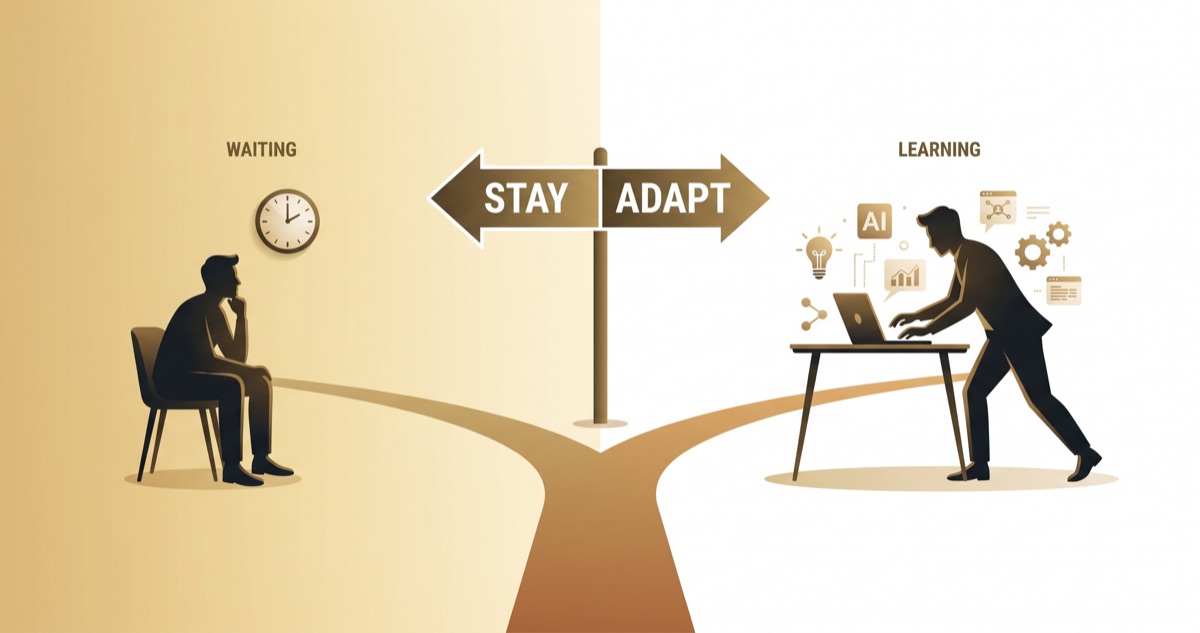
In Part 3, I shared a number that's hard to ignore: 44% of core skills will change by 2030. That raises an obvious follow-up — how do you actually prepare? This is where AI reskilling enters the conversation. Throughout this series, I've been pulling data points to map out what's happening. Today, the focus shifts from analysis to action.
The Urgency in Numbers
The World Economic Forum's Future of Jobs Report 2025 estimates that 59% of the global workforce — roughly 120 million people — will need AI reskilling by 2030. That's more than four times the entire working population of South Korea.
The supply side tells a different story. Only 46% of companies currently offer internal AI upskilling programs. Less than half. And 11% of workers are unlikely to receive any form of training at all — a complete blind spot.
Meanwhile, 58 million workers completed AI-related certifications in 2025 alone. The people who are moving are already moving. The question is whether you're one of them.
Why "My Company Will Handle It" Is a Dangerous Bet
It's a reasonable assumption. Your employer has a vested interest in keeping the workforce current. But there are three problems with relying on that assumption.
It's a Big-Company Privilege
The companies investing heavily in AI reskilling tend to be large enterprises with dedicated L&D budgets. Small and mid-sized businesses are stretched thin just staying operational. Before assuming your company will train you, ask whether it has the budget to do so.
Company Training Serves Company Needs
Corporate AI training is designed around the organization's priorities, not yours. Your company might teach you how to use a specific internal tool. What you actually need might be the ability to redesign your entire workflow with AI. Those are different things.
It Resets When You Leave
This is the biggest weakness of company-dependent AI reskilling. The skills are often tied to proprietary systems and internal tools. Change jobs, and you're starting over. Self-directed AI skills — understanding how to evaluate, prompt, and integrate AI tools into any workflow — are portable. They follow you.
Where to Start with AI Reskilling
Here's a common misconception: AI reskilling means learning prompt engineering or picking up Python. That's developer reskilling. For most professionals, the starting point is different.
It's not about studying. It's about using tools.
A practical framework:
- Test one AI tool per week on your actual work — ChatGPT, Claude, Copilot, whatever is accessible. The point is hands-on use, not theoretical knowledge
- Map your task list and find where AI fits — draft reports, data cleanup, email composition, meeting summaries. These are low-risk, high-return starting points
- Skip "perfect prompts" — focus on "AI in my workflow" — the goal isn't mastering prompt syntax. It's cutting 30% of repetitive work
- Document what you try — what worked, what didn't, what surprised you. This becomes a portfolio over time
In Part 1, I wrote about how quickly younger workers adapt to change. They pick up tools fast. But people in their 40s have a different advantage.
AI Reskilling in Your 40s Looks Different
Yes, people in their 20s learn new tools faster. Lower resistance, shorter learning curves. But AI reskilling isn't just about tool proficiency.
Domain Expertise Is the Multiplier
Professionals in their 40s bring 10-plus years of domain knowledge. AI is a general-purpose tool, and general-purpose tools become exponentially more valuable when combined with deep domain context. A finance veteran automating analysis reports with AI produces fundamentally different output than someone who knows AI but not finance.
Domain expert + AI = hard to replace. That's the formula for AI reskilling in mid-career.
The Learning Scope Is Narrower
Workers in their 20s are building job competency and AI skills simultaneously. In your 40s, the job competency is already there. You only need to learn how to plug AI tools into existing workflows. The learning scope is smaller, but the impact is larger.
In Part 3, I shared data showing that AI-skilled workers earn 56% more in the same roles. That premium hits hardest for domain experts who can wield AI as a tool — not for people who only know the tool.
The Structure of Falling Behind
Let's talk about timing. "I'll learn when I need to" sounds rational. In practice, it doesn't work.
- The speed of change: 44% of core skills shift within five years. By the time you "need to," it's already too late
- Learning takes time: Integrating AI tools into your workflow naturally requires 3 to 6 months of trial and error
- Start when you have margin: When a crisis hits, there's no bandwidth for learning. Right now is the most relaxed you'll be
120 million people need AI reskilling. Half will get help from their employers. The other half need to move on their own. Pull up your task list. Pick one repetitive task. Try running it through an AI tool next Monday. AI reskilling isn't a massive project. It's one task, one tool, one week at a time. That's how it starts.