Claude Design Market Reaction — What Figma’s Stock Drop Really Signals
Three weeks after Claude Design’s launch, Figma’s stock dropped 7% and designers split between panic and praise. Here is the full breakdown of market reaction, competitive landscape, and 12-month outlook.
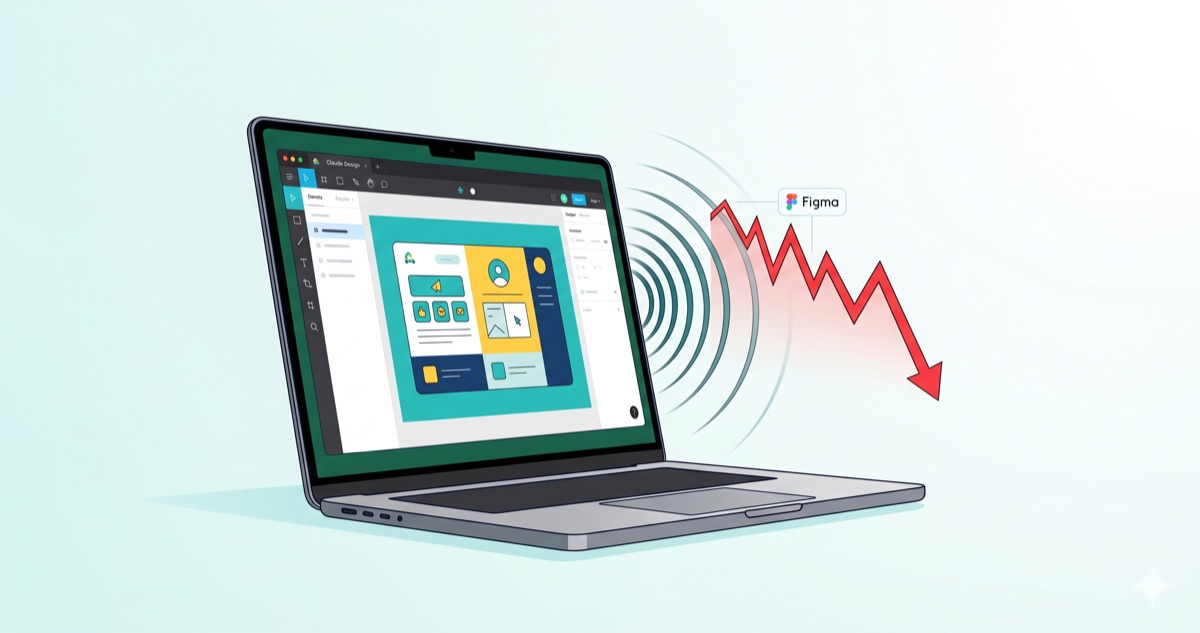
Claude Design Market Reaction — Figma's Stock Dropped 7% on Launch Day
The Claude Design market reaction was immediate and dramatic. When Anthropic released Claude Design as a research preview on April 17, 2026, Figma's stock fell roughly 7.3% on a closing basis ($20.32 → $18.84). The market read it as a clear signal — Anthropic's Chief Product Officer, Mike Krieger, had stepped down from Figma's board on April 14 (SEC disclosure followed on April 16), just three days before the launch.
A previous post covered the Claude Design handoff structure in detail, but the market moved faster than the feature itself. This article walks through three weeks of market response, the competitive landscape, and the 12-month outlook.
Designer and Industry Reactions
Positive — "Twenty Prompts Down to Two"
The most striking testimonial came from a senior product designer at Brilliant: complex pages that previously required twenty or more prompts in other tools could be completed in just two prompts with Claude Design.
Wharton professor Ethan Mollick captured another sentiment on X — Claude Design "ended the tyranny of purple gradients and Arial fonts." It was a jab at how previous AI design tools produced near-identical outputs. Claude Design appears to actually consider the audience context.
Negative — Credit Drain and Governance Gaps
The criticism is just as substantial.
- Credit drain: One Hacker News user reported burning through 95% of their weekly allowance in a single session. Multiple cases describe a single complex task consuming over half the weekly quota.
- First-output polish: Color choices and spacing often feel awkward. The output works as a draft but rarely as a finished product.
- Governance gaps: Anthropic's official documentation acknowledges that audit logs and usage tracking are not supported. That is a hard blocker for enterprise adoption.
X saw a wave of "Designers are done" panic posts, but actual practitioners largely treat Claude Design as a powerful drafting tool — not a replacement.
Korean Market Reception
Reception in Korea has skewed positive. Major outlets like DIGITAL iNSIGHT, engineer Dale Seo's blog, and Brunch published analysis posts within days of launch.
The notable pattern is who they recommend it for. Korean AI communities like GPTers actively promote Claude Design to PMs and solo founders, suggesting a hybrid workflow — use Claude Design for key scenes, then finish in Figma or Canva. The framing is augmentation, not replacement.
The credit drain issue is a shared frustration across markets. Hitting the limit within days on a $200/month Max plan is a complaint heard equally in Korean and English-speaking communities.
Competitive Landscape — Claude Design vs Figma vs v0 vs Galileo
Here is how each tool positions itself today.
| Tool | Core differentiator |
|---|---|
| Claude Design | Conversational, not canvas-first; scans codebase for design tokens; Claude Code handoff bundle |
| Figma First Draft / Make | 372 prebuilt components, interactive prototypes, mature ops tooling |
| v0 (Vercel) | Generates real app code, not mockups |
| Galileo AI | Pitch-deck-grade high-fidelity UI comps |
| Uizard | Low-fidelity wireframes and user flows |
Analyst consensus on the short-term winner is clear: hybrid teams that put Claude Design upstream (ideation) and Figma downstream (production) are the immediate beneficiaries. Claude Design's handoff bundle closes the loop into code, but Figma still owns mature design operations — shared libraries, dev mode, branching.
12-Month Outlook for Claude Design
Confirmed Information
- Anthropic launched Claude Design with an explicit Canva partnership announcement. Canva CEO Melanie Perkins gave a direct quote about ideas and drafts flowing from Claude Design into Canva for collaborative editing, and parts of Claude Design are powered by Canva's Design Engine. More third-party integrations are signaled in the same announcement.
- Pricing remains Pro $20, Max 5x $100, Max 20x $200, with overage billed on a metered basis. Quota adjustments and metered expansion seem more likely than headline price hikes.
Verified Analyst Outlook
Claude Design appears poised to absorb the "PM and founder builds the prototype before calling a designer" segment. Meanwhile, the following remain Figma's clear advantage for the foreseeable future.
- Shared design library operations
- Developer handoff (dev mode)
- Branching and version control
- Enterprise governance — permissions, audit, compliance
Next Checkpoint — Figma Q1 Earnings on May 14, 2026
The closest milestone is Figma's Q1 FY2026 earnings call on May 14, 2026 at 5 PM ET. If AI revenue growth misses consensus, additional stock pressure is likely, which in turn affects Anthropic's negotiating leverage with potential partners.
Unconfirmed Areas
- The general availability (GA) timeline has not been announced.
- The shape of formal pricing changes is not publicly disclosed.
These two areas attract heavy speculation. Until Anthropic announces, treat any specific claim with skepticism.
Claude Design Market Reaction — Wrap-Up
The Claude Design market reaction reads less like a product launch and more like a power-shift signal in the design tooling industry. Figma's immediate stock response, the timing of Mike Krieger's resignation, and the polarized designer community all point in the same direction.
In the short term, however, the realistic picture is augmentation — not replacement. The most-recommended workflow remains the hybrid model: Claude Design for ideation, Figma for production. The May 14 Figma earnings call will be the first real inflection point that either confirms or unsettles this balance.