Modu AI, Tested Firsthand — Two Programs With One Name, and a Concept Still Missing
Korea's free national AI, Modu AI, launches in December, and the Modu AI Lab that's open today is a separate program. I tried vibe coding in the Lab, then compared the government's GPU budget with the big US AI labs. AI independence matters, but the project needs a clear concept of how it differs from Big Tech AI.

Modu AI ("AI for Everyone") is Korea's free national AI. Starting in December, the government is rolling out AI chatbots built by SKT, KT, and Kakao to every citizen at no cost through 2028. But the Modu AI Lab, where you can try vibe coding right now, is a separate program that just happens to share the name. I spent some time vibe coding in that Lab, and my honest takeaway was: I still can't tell what this service is trying to be.
I do think AI independence matters. But the GPU budget behind Modu AI is orders of magnitude smaller than what the big US labs run, and matching hardware alone wouldn't close the gap anyway. If Modu AI is going to work, it needs a clear concept first: what makes it different from Big Tech AI.
This post walks through the difference between the two programs, what I saw when I tried it, a scale comparison, and the arguments on both sides. My own verdict is kept to the end.
Modu AI and the Modu AI Lab are two different programs
The names are nearly identical, and at first I assumed they were the same thing. They aren't. The agencies, the companies doing the work, and what "free" means are all different.
| Modu AI Lab | Modu AI | |
|---|---|---|
| Address | aitestbed.kr (vibe coding at vibe.aitestbed.kr) | Launching in December |
| Run by | Ministry of Science and ICT and the National Information Society Agency (NIA) | Ministry of Science and ICT |
| Built by | A platform operator under contract through December 2026 | SKT, KT, and Kakao consortiums |
| What it is | A sandbox for building AI services with vibe coding, plus a competition | A general-purpose AI chatbot and public-service AI agents for everyone |
| How it's free | About 40,000 won (roughly $30) in credits per person, after completing an AI ethics course | Free through 2028; what happens after is still being negotiated |
Modu AI: a national chatbot on homegrown foundation models
Modu AI is built on Korea's "sovereign AI foundation model" program, a government effort to develop domestic large language models. The ministry picked SKT, Kakao, and KT out of six bidding consortiums, and each one gets 512 Nvidia B200 GPUs. The plan also includes services tailored to older adults and other underserved groups.
The target launch is December. Some reports name December 15, but that hasn't been officially confirmed, and the three operators are reportedly in beta testing. The service is free through 2028. According to the minister, whether government funding continues after that is still under discussion with the companies.
Modu AI Lab: a vibe coding playground
The Modu AI Lab is an online platform run by the ministry and NIA so that anyone can try building a service with AI. Sign up, finish an AI ethics course, and you get roughly 40,000 won in vibe coding credits. Right now the home page is plastered with event pop-ups: a vibe coding event with prize giveaways and a "Burn through your 40,000 points" event running November 17 to December 6.
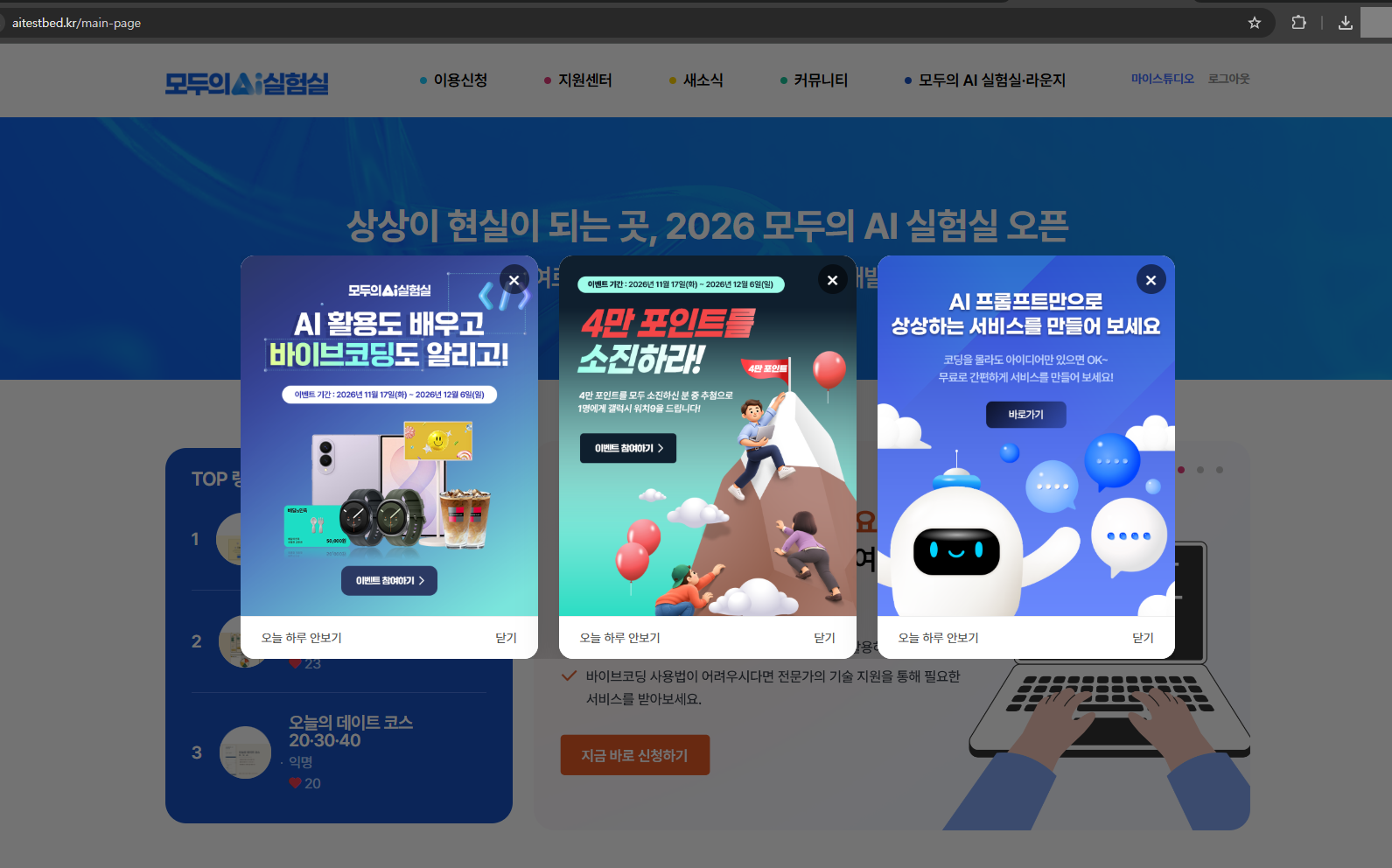
I couldn't find which AI model the Lab actually runs on in its public materials. Whether it's a Korean foundation model or an overseas one would change the evaluation a lot, so I'm not going to guess.
Vibe coding in the Modu AI Lab
I normally vibe code with Claude and ChatGPT. I took the same approach in the Lab, building and tweaking a simple Tetris game, and burned through about 4,800 points. My balance dropped from 40,000 to 35,191, which works out to a little over 5,000 won, or about $3.50.
The interface: familiar layout, classroom vibe
The screen has a chat panel on the left and Preview, Code, API, and DB tabs on the right, the same layout most vibe coding tools use these days. There's also a "prompt helper" that restructures your request into what to change, where, how, and what to leave alone before sending it. That's a thoughtful touch for people who don't code.
Still, the overall feel was closer to a kids' coding platform like Scratch, or Entry, its Korean counterpart. The prize events, the points-burning challenge, and the mandatory ethics course made it feel less like a tool you'd actually work in and more like a program you try once. That isn't wrong in itself. It just wasn't what someone who vibe codes for real work was expecting.
The result: it fell short
My request was small: make the trail of the falling block look different from the blocks already stacked. The AI listed its changes point by point and replied, "Build and run check complete." But when I took the screenshot, the preview pane was still stuck on "Reloading the session and building."
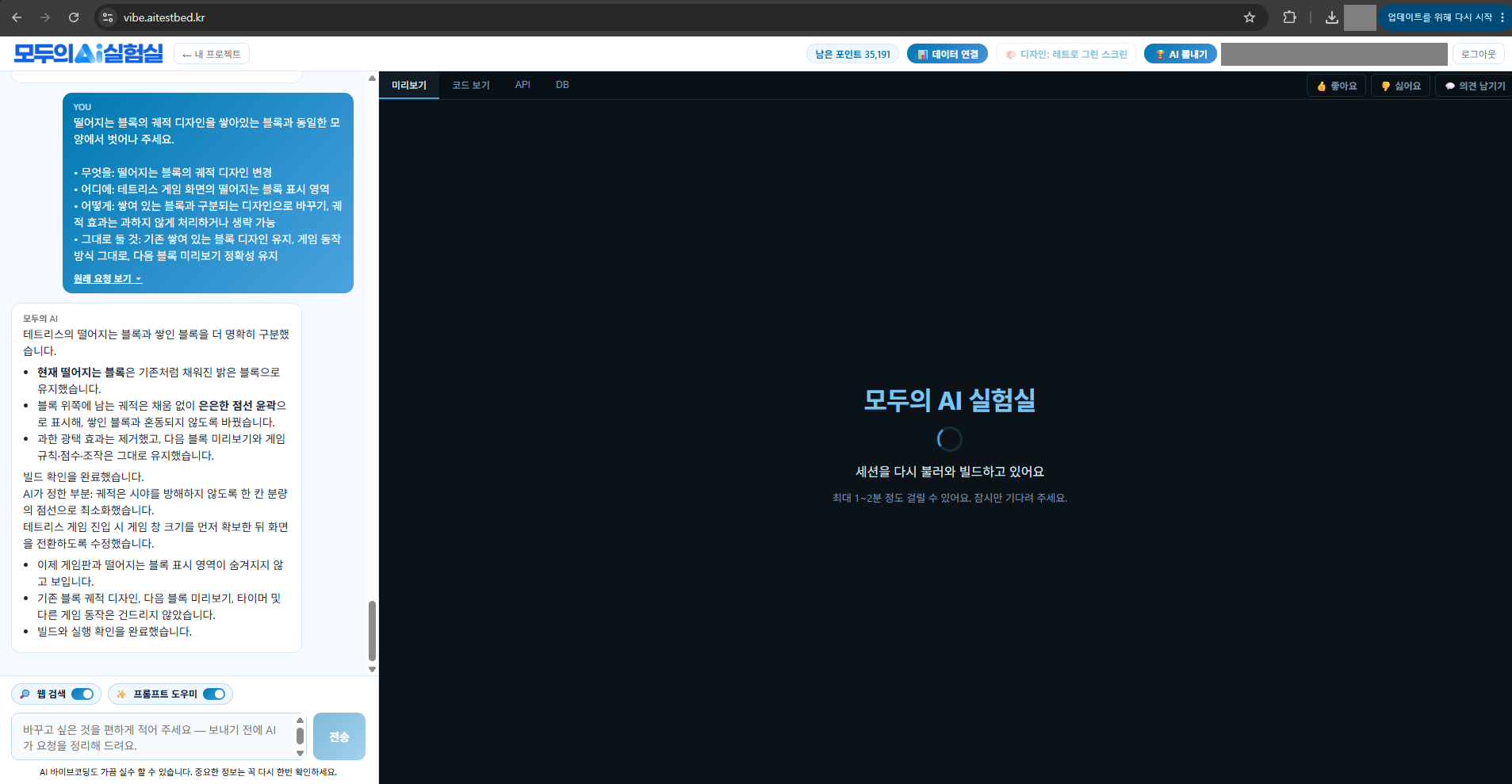
After spending about $3.50, I was pretty disappointed. Honestly, it isn't yet in the same league as the tools from the big AI companies I use every day.
To be fair, this evaluation has limits. Modu AI itself hasn't launched yet, and what I tested was the Lab, a separate program. The test was also small: one simple game and a few dollars of credits. So I'm not going to stretch this into "government AI is useless." The narrower claim is that the Lab, as it stands, isn't ready to be a working vibe coding tool.
Putting the scale in perspective — Modu AI vs. the big AI labs
"It's a lightweight model" is the usual explanation, but I had no real sense of how big the gap is. So I lined up the public numbers.
| Who | Reported scale | Source type |
|---|---|---|
| Modu AI (one operator) | 512 B200 GPUs | Ministry announcement |
| Modu AI (all three) | About 1,500 B200 GPUs | Sum of the above |
| Korea's foundation model teams (last year) | At least 1,000 GPUs per team | Korean press |
| xAI Colossus 1 (a single data center) | Over 200,000 GPUs | International press |
| OpenAI | About 2 GW available, 30 GW targeted by 2030 | Analysts and press |
| Global AI compute | Over 100 GW at the end of 2025 (estimate) | Industry analysis |
This is not a precise comparison. The units mix GPU counts with power in gigawatts, the US figures mix capacity that's online with capacity that's only under contract, and many sources are analyst write-ups rather than official filings. Read it for orders of magnitude, not exact ratios.
Here's one back-of-the-envelope check. A B200 draws roughly 1 kW, so 1,500 of them come to about 1.5 MW for the chips alone. OpenAI's reported 2 GW is 2,000 MW, a gap of more than 1,000x even on this crude math. Compared with just one xAI data center, the GPU count differs by more than 100x.
Matching the hardware wouldn't be enough
Buying 1,000 times more GPUs wouldn't solve it either. The big labs' edge comes from years of accumulated advantages beyond hardware:
- The volume and quality of training data, and the know-how to clean it
- Research teams that design and keep improving the models
- Usage data and iteration from hundreds of millions of users
- Purpose-built tools and ecosystems, vibe coding included
That's why the same GPUs don't produce the same model. Flip it around, and the more important question is what Modu AI will do differently instead of trying to win on scale.
Why the government is building its own AI — the case for
This isn't only a story of criticism. The case in favor is clear.
AI sovereignty and independence
If a country relies entirely on foreign Big Tech, someone else controls the pricing, the data, and access. If they raise prices, cut off service, or deprioritize Korean-language quality, there's little anyone can do. In that view, owning homegrown models is leverage and insurance. I agree with this part.
Closing the digital divide
Paid AI plans cost tens of dollars a month. For people who can't afford that, free AI can be the first step. Modu AI's plans for older adults and underserved groups come from the same idea. From this angle, the Lab's classroom feel might even be a strength.
Academics have said much the same: serving many users with lightweight models has real limits and isn't suited to development or research, but making the attempt with a tight budget still has value.
The case against
The concerns on the other side are specific too.
Not enough GPUs for a national service
Critics point out that 512 B200 GPUs per operator is small next to the 1,000-plus per team given to last year's foundation model teams. Some say serving the whole country would take tens of thousands of GPUs, and one industry estimate puts concurrent capacity at around 14,000 requests per 256-GPU unit. Optimization could push that up, but when usage spikes, speed and quality are likely to slip first.
The foundation model program underneath is wobbling
In the first evaluation of the foundation model program, Naver Cloud and NC AI were dropped, and some in the industry said the program has effectively stalled. The government insists that building models and spreading services aren't an either-or choice, but a service built on a weak base model will hit clear limits.
Who pays after 2028?
It's free through 2028. After that, whether the government keeps funding it, the companies pick up the bill, or it goes paid is undecided, and critics keep pointing to an unclear business model. As a taxpayer, what I most want to know is whether this budget turns into real service quality, and what's left when the program ends.
So what should Modu AI be? It's a concept problem
Right now, the "Modu" name covers things that are quite different from each other: a general-purpose chatbot competing with ChatGPT, a program teaching citizens to use AI, and AI agents for public services. That's exactly why, before launch, I couldn't tell what the concept was.
If competing on scale isn't realistic, it should pick the places where big AI is weak or uninterested. Here's where I'd look:
- Public data integration: agents that actually handle civil petitions, welfare applications, and taxes
- Korean institutions: laws, government support programs, and local administration, where foreign AI often gets things wrong
- Digitally excluded users: plain language, voice, and large text, with accessibility designed in from the start
- Education: if the Lab is really an educational tool, say so and own it. Tying it to schools and job training would outlast prize giveaways
What you can do right now
- If you're new to vibe coding, the Modu AI Lab's free credits are a low-risk way to try it, and the prompt helper is a good way to learn how to structure a request.
- For real coding work or long documents, paid AI is still the better choice. If cost is the worry, see this AI credit comparison across Claude, ChatGPT, Gemini, and Grok, or this Codex vs. Claude Code comparison if you're picking a coding tool.
- When Modu AI launches in December, check three things: whether there are usage limits, how your conversations are stored and whether they're used for training, and what the terms look like after 2028.
Wrapping up
Modu AI is Korea's free national AI, launching in December through SKT, KT, and Kakao. The Modu AI Lab, where you can vibe code today, is a separate program. My hands-on test showed the Lab isn't ready to be a working tool yet, and the government's GPU budget sits orders of magnitude below the big US labs.
I still believe AI independence is worth pursuing. But adding hardware won't close the gap on its own, and policy, like vibe coding, needs direction before tools. Modu AI has to be clear about how it differs from Big Tech AI and who it's for, or this budget won't leave much behind. The big labs themselves keep changing amid outages and competition. Rather than chasing them, deciding where Korea can actually win is the first step Modu AI needs to take.