From On-Device AI to Hybrid AI — How Routing Defines the Next Two Years
On-device AI is the hot topic right now, but real products are converging on Hybrid AI. Here’s why the on-device wave leads to hybrid, the four routing patterns that make it work, and what builders should focus on next.
Why On-Device AI Suddenly Became the Hot Topic
On-device AI means running models directly inside the device you hold — phone, laptop, car — instead of sending data to a cloud server. The NPU (neural processing unit) inside the chip does the math. Results come back faster, data never leaves the device, and things keep working when the network drops. It's also the first step toward where most AI products are actually heading: Hybrid AI.
This idea moved to the front of IT news in the last year for three reasons.
First, the cost of cloud LLMs hit a wall. Every call adds API spend, network latency, and the awkward fact that user data leaves the device. As covered in the Claude Opus 4.8 guide, the models themselves keep getting better — but so do the bills and the privacy questions that come with each call. In a world where one user pings AI dozens of times a day, that bill compounds fast.
Second, NPU hardware finally settled in. Apple's Neural Engine has lived in the M-series and A-series chips for years; Qualcomm's Snapdragon X Elite and Intel's Core Ultra are putting serious NPUs into PCs. Microsoft's Copilot+ PC category exists because there's a hardware floor you can now assume. The physical capacity to run a model locally is no longer the bottleneck.
Third, small language models (SLMs) got real. Google's Gemma, Microsoft's Phi, and Meta's Llama 3.2 1B and 3B run inside laptops and phones at a few billion parameters each. A lot of the work that only cloud models could handle a year or two ago now finishes on-device.
That's why on-device AI is the topic of the moment. But it's worth saying where the trend is heading — and the destination is Hybrid AI.
On-Device Ships Everywhere, but Real Products Are Hybrid
On-device AI is showing up in basically every device category. Phones have Apple Intelligence and Galaxy AI running voice assistants, translation, and photo editing on the NPU. Laptops have Copilot+ PCs, Apple Silicon MacBooks, and Intel AI PCs heading the same way. Cars already use edge AI in ADAS and infotainment.
The interesting twist: none of these products actually go pure on-device. The shipping versions are almost always hybrid. Three reasons make this inevitable.
- SLMs are fast and private but small. Heavy reasoning, fresh information retrieval, and multi-agent workflows that frontier LLMs handle are out of reach for a 3B-parameter model.
- User expectations are already calibrated to cloud LLMs. "At least as good as ChatGPT" is the floor, and pure on-device can't always clear it.
- Sending everything to the cloud brings back the cost, latency, and privacy weight that on-device was supposed to lift.
Neither extreme works. The natural answer is to split the work — fast and private things on the device, heavy and complex things in the cloud. That split is what people mean by Hybrid AI.
The Four Routing Patterns That Drive Hybrid AI
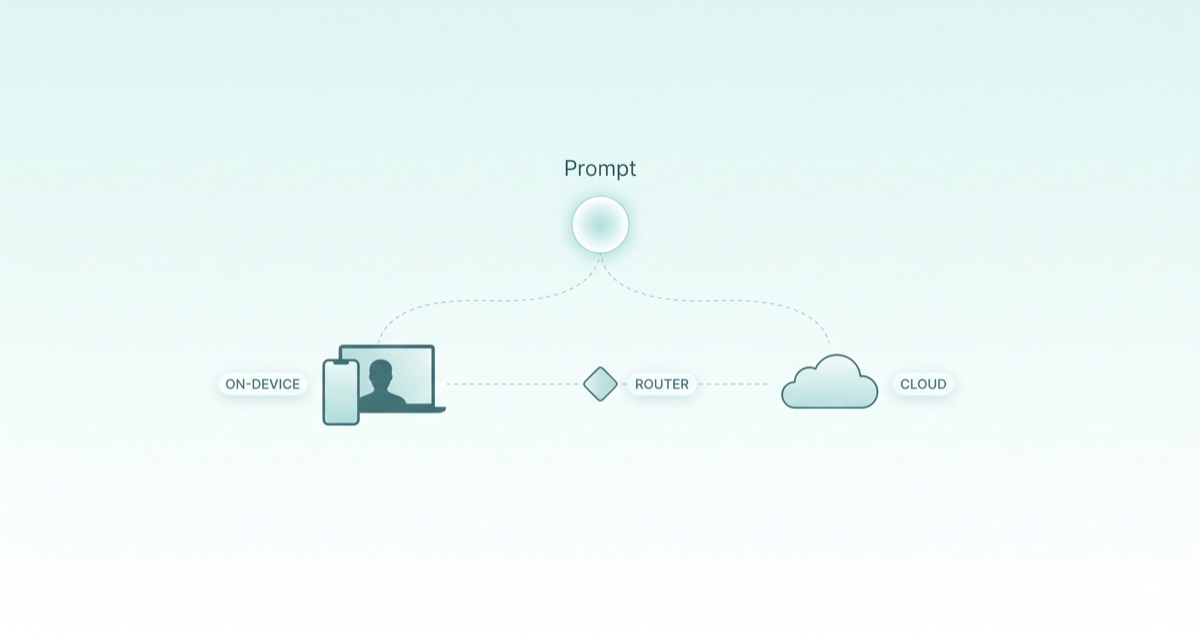
What makes Hybrid AI hybrid isn't the models — it's the routing policy. When a prompt arrives, an on-device "AI orchestrator" decides whether the work stays local or gets pushed to the cloud. Four signals usually drive that decision.
1. Privacy-First Routing
The orchestrator scans incoming data locally for things like national IDs, account numbers, passport details, or company-internal terms. If anything PII-shaped shows up, the work stays on the NPU regardless of network quality. From a product perspective, what counts as "sensitive" is a policy call — and if that boundary is fuzzy, the routing on top of it is fuzzy too.
2. Context-Size Routing
"Fix the grammar in this email" finishes on-device in under a second. "Summarize the 50 reports we wrote last year" — tens of thousands of tokens, multi-step reasoning — gets offloaded to a frontier model in a data center. For developers, this brings token counting back into the client-side decision layer. Input length and task depth become a first-line branch.
3. Cost & Connectivity Routing
When the device is offline or in airplane mode, all compute is forced local by definition. Online, big tech wants to keep cloud bills down, so the orchestrator tries to solve locally first and only does cloud bursting when the confidence score drops below a threshold. Cost cascades down to users too — free tiers that stay on the device, paid tiers that unlock cloud capacity, is going to be a familiar pattern.
4. Hybrid RAG — Result Synthesis
The most interesting routing. A request like "find photos in my gallery that look like the place from yesterday's news" can't be solved on either side alone. The cloud searches today's news for the location, ships that hint down to the device, and the on-device model digs through the local photo library to match. Two models cooperate inside a single query.
What Hybrid AI Actually Solves
The four Hybrid AI routing patterns are already running in shipping products. Three quick examples.
Phone Camera and Gallery
Apple Intelligence and Galaxy AI use nearly the same pattern. The instant work — subject detection at shutter time, skin-tone correction, live text recognition — runs on-device because latency isn't negotiable. Generative edits that erase a person from a background, or semantic searches like "find the noodle photos from Jeju last fall," go to the cloud because they need heavy multimodal compute.
Real-Time Voice Assistants and Translation
Speech-to-text, "Call Mom," "Turn off the alarm," and simple offline 1:1 translation all run on-device for snappiness. Composite requests — "the supplier email feels stiff, draft a softer reply, then sync it with my flight booking" — touch third-party APIs and need business-context reasoning, so they go to the cloud. Agentic AI like Gemini Spark lives squarely in that composite layer.
Self-Driving and Connected Cars
Emergency braking detection, lane-keeping, pedestrian recognition — the safety-critical control loop — runs on the in-car edge computer alone. Tunnels and dead zones can't be allowed to break those systems. Route re-planning based on live traffic, infotainment chats about nearby restaurants, and OTA update optimization sit in the cloud and talk to the car in the background.
Where to Focus for the Next Two Years
One trend is clear: the routing boundary gets redrawn every year. On-device models keep getting more capable, so work that needed the cloud last year ends up local this year. Meanwhile, frontier models keep extending — million-token contexts, multi-agent workflows, tool use — into spaces only the cloud can serve. Both sides deepen, and the routing policy between them grows more refined.
For builders, that means the next two years of Hybrid AI work concentrate around a small set of questions.
| Focus area | The question to answer |
|---|---|
| Routing policy | Which tasks belong on the device, which belong in the cloud? |
| Sensitive data boundary | What data must never leave the device? |
| Response-time branching | How does the UI handle one function that may finish in 100ms or in 3s? |
| Offline fallback | What degrades gracefully when only the device is alive? |
| Cost tiering | How do free and paid tiers differ in their routing? |
Routing policy is mostly decided by the OS and the platform, not the app. Apple Intelligence's routing isn't something an app can override, and Galaxy AI is similar. App developers call the on-device SDK and don't always get to choose where the work lands. The practical consequence: design your UI assuming both response times can show up from the same call.
The biggest decision for product people is the sensitive-data boundary. If that line is unclear, the routing logic on top of it is unclear too, and user trust erodes from there.
Smart Routing Is the Real Edge in Hybrid AI
On-device AI rose because cloud LLMs hit their cost-latency-privacy ceiling. The fix — pushing more work to the device — runs into its own ceiling pretty quickly. Hybrid AI is the smart traffic-control layer that sits between the two.
The essence of Hybrid AI isn't the models. It's the routing policy: handing immediate UX and privacy to the device, outsourcing the deep knowledge base and heavy reasoning to the cloud, and orchestrating both so the user only ever sees one experience.
For the next couple of years, that orchestration is where most AI products will quietly end up converging on Hybrid AI.