Why Fallback Matters Again in the MSA and AI Era
Fallback is an old idea that has quietly become essential again. Microservices, LLM adoption, and UX pressure made it a default tool — here is why, with examples.
An Old Concept That Is Suddenly Everywhere
Fallback is not a new word. "If the primary path fails, switch to a secondary path so the service keeps running" — you can find that line in system design textbooks from thirty years ago. Yet over the last year or two, the word has been showing up in product and engineering meetings far more often. There is a reason. Both the frequency and the shape of failure have changed at the same time.
In the old monolithic world, a failure usually meant the program stopped or a 500 error page appeared. Users tolerated that. Today, dozens of services sit behind a single screen, one of them is probably an LLM, and users expect today's session to feel as polished as yesterday's ChatGPT call. In that environment, "show an error page and move on" is close to a death sentence for the feature.
This post revisits what fallback actually means, why it has become essential again right now, and how product managers and engineers should apply it in practice.
What Fallback Really Means — Another Name for Graceful Degradation
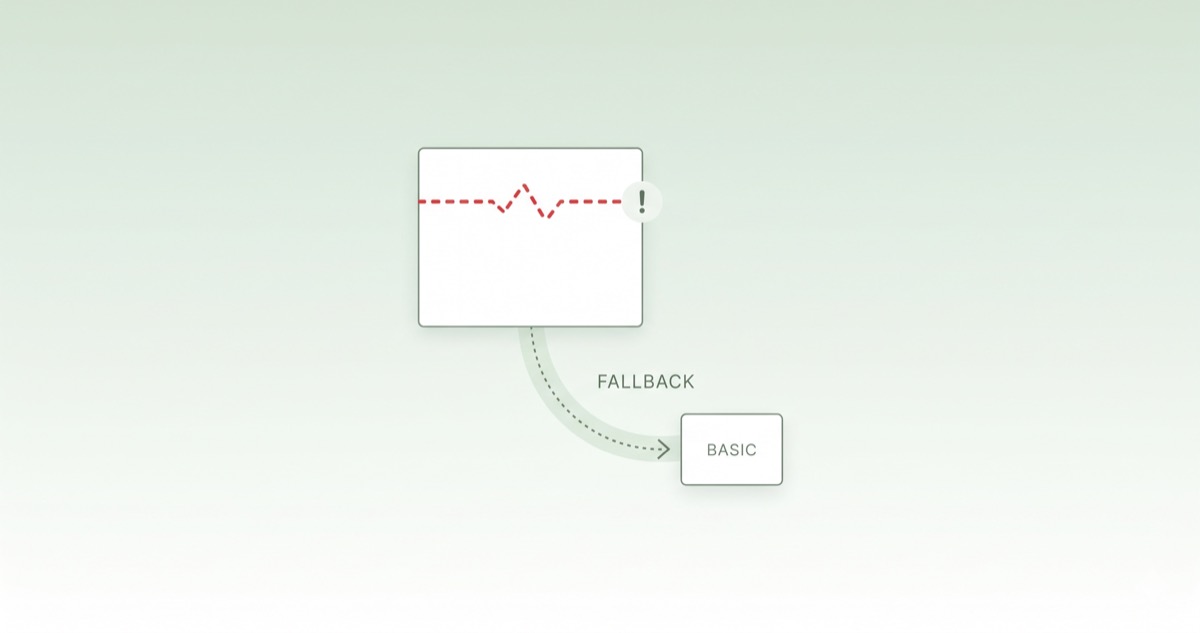
A fallback is a design that keeps a system running in a reduced state when the primary capability fails, instead of stopping completely. In English-speaking engineering circles, it often sits next to the broader term graceful degradation. Two ideas sit underneath it.
First, failure is not avoided — it is assumed. The design starts from "this will fail at some point." Second, the failure is intercepted before it reaches the user and swapped for a substitute response. The user perceives "the feature got a little simpler," and the service does not stop.
The mindset is decades old. The difference now is that it used to be a "nice to have." Today it is closer to "you cannot ship without it."
Why Fallback Is Showing Up More Often Today
Three shifts explain the renewed weight on fallback.
Microservice Architecture (MSA)
Modern services split payments, recommendations, authentication, search, logging, and notifications into separate components that talk to each other. If the recommendation service goes down, the entire app must not refuse to open. The recommendation surface should swap to a fallback like "default popular items," while payments and search keep working as normal. Once services are sliced thin, partial failure becomes the everyday case, and fallback is the standard tool for handling it.
AI and LLM Adoption
LLMs fail in more diverse ways than deterministic programs. Responses come back slow, sometimes wrong, sometimes blocked by content filters, sometimes the API itself is briefly down, sometimes a budget cap cuts the call short. Failure is less an exception and more a probability distribution. That is why designs like "if the AI response takes more than five seconds, show a pre-written template answer" or "if confidence drops below a threshold, fall back to a rule-based reply" have effectively become required. The hybrid AI routing post covered recently is, at one level, exactly this — when the cloud is unreachable, requests fall back to the on-device SLM.
Rising UX Expectations
A blank error page used to signal "please bear with us." Today, a user who hits a wall on one service is one second away from the competitor. Instead of pushing users out with an error screen, keeping them in a "limited but still usable" state has become directly tied to retention metrics. Fallback is no longer just a technical design pattern — it is a product policy.
Applying Fallback by Role
Product managers, engineers, and designers all use the word "fallback" in the same meeting, but the picture in their heads is often different. Splitting the concept into two branches usually speeds up the conversation.
Technical Fallback
This is the code-level kind, dealing with backends, infrastructure, and external API failures.
- External API outage: When a third-party weather API is down, instead of crashing the system, show the most recently cached weather data or fall back to a "Seoul default."
- Network conditions: When a user's connection drops or slows, automatically switch from HD to a lower-resolution stream so playback continues.
- LLM response fallback: If the primary model call times out, is rate-limited, or gets blocked by a content filter, retry with a lighter secondary model or fall back to a pre-written structured answer.
- AI tool outage: The earlier guide on switching to a backup CLI when Codex is down is the same idea applied to developer tooling — when the primary tool is unavailable, switch to a secondary one without interrupting the workflow.
UI/UX Fallback
This is the screen-level kind, about how the substitute appears to the user.
- Image load failure: When a hero banner fails to load, show a default fallback image with the company logo instead of a broken icon.
- Web font failure: To handle a missing licensed font, declare a chain such as
font-family: 'PrimaryFont', 'AppleSDGothicNeo', sans-serif;so the next font in the list takes over. - AI response delay: While the model is thinking, show a skeleton UI or a "see past answers to similar questions" panel so perceived latency shrinks.
- Payment module failure: If the primary payment method fails, immediately surface a secondary entry point such as "try with simple pay" inside the same screen.
Four Things to Get Right When Designing a Fallback
A short table of the points teams most often miss.
| Design point | Question to ask |
|---|---|
| Trigger | What exactly counts as "failure" — a timeout, an error code, a confidence threshold? |
| Quality of the fallback result | Is the substitute meaningful enough that it does not erode user trust? |
| Visibility | Should the user know they are in a reduced mode, or should it be silent? |
| Observability | Can you track how often, when, and why the fallback fires? |
The last row is the one teams most often forget. When a fallback works well, users never see it — which means engineering can stay unaware that the primary path has been quietly failing for weeks. Putting "fallback firing rate" on a dashboard is essentially mandatory.
A System That Refuses to Stop Is the Real Product
Fallback is a thirty-year-old idea, but it carries new weight now that systems are sliced thin, AI sits in the middle of the stack, and users compare every screen to the best app they used yesterday. The core is simple. Failures will happen. The user should experience them as a smaller version of the feature, not as a stop.
If you are a product manager, write "what should the user see if this feature fails?" into the spec from the start. If you are an engineer, treat the fallback path of every external dependency as part of code review, not a follow-up ticket. If you are a designer, draw one extra screen behind the happy state, the loading state, and the error state — the "reduced mode" screen.
A system that refuses to stop is, in the end, a product that users do not abandon. Fallback is the simplest and most powerful place to start.